
Sayin Silences Michigan as Ohio State Locks Down No1 Seed While Texas A AND M Upset Reshapes Entire Playoff Bracket
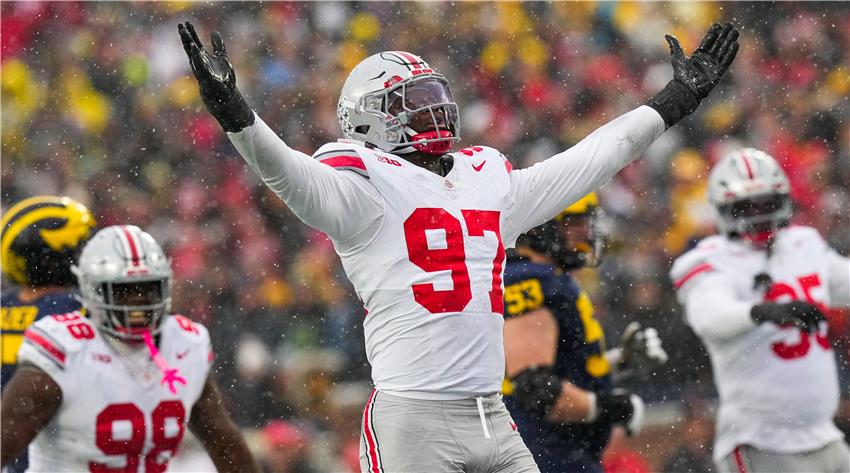
Rivalry Week delivered the perfect cocktail of dominance and chaos that will reverberate through April's NFL Draft. While Julian Sayin orchestrated Ohio State's methodical 27-9 dismantling of Michigan to cement the Buckeyes as national championship favorites, Texas' stunning 27-17 upset of previously unbeaten Texas A&M completely reconfigured the playoff bracket and provided crucial final data points on dozens of draft prospects
Week 14 Chaos Sets Stage for Conference Championship Drama
The regular season finale delivered exactly what college football needed heading into Championship Week—clarity at the top and absolute chaos everywhere else. While Julian Sayin and Ohio State methodically dismantled Michigan in Ann Arbor, the rest of the playoff picture fractured into a thousand pieces, leaving NFL scouts scrambling to recalibrate their draft boards one final time before bowl season.
Ohio State's 27-9 victory over Michigan wasn't just another win—it was a statement. The Buckeyes entered the most hostile environment in college football and played like a team that has been there before, because they have. Jeremiah Smith and Carnell Tate each hauled in touchdown passes of 35 and 50 yards respectively, showcasing the type of explosive playmaking that will translate seamlessly to Sundays. But it was the defense that truly dominated, holding Michigan to just 78 yards over the final three quarters.
Kenyatta Jackson continued his ascent up draft boards with another disruptive performance along the defensive line. The Buckeyes have allowed more than 10 points just twice all season, and their machine-like consistency has them positioned as the clear favorite to win the national championship. In recent weeks, scouts have increasingly viewed this playoff as "Ohio State versus the field," and nothing that happened during rivalry weekend changed that calculus.
The Quarterback Conundrum Deepens
If you were hoping Week 14 would bring clarity to the quarterback class, you're still waiting. Indiana's Fernando Mendoza has clearly established himself as the frontrunner after another composed performance, but the gap between him and the rest of the field remains narrow. At 6-foot-5 and 225 pounds, Mendoza possesses the prototypical size scouts covet, and his 29 career starts provide the experience base that others in this class lack.
Oregon's Dante Moore continues to intrigue evaluators despite limited experience. His ability to execute plays all over the field with just 16 career starts speaks to advanced processing skills, but scouts remain divided on whether he needs more seasoning. An NFC West scout noted that Moore is "doing all the little things well" and praised his poise under pressure, though acknowledged he "will force a pass" on occasion.
Alabama's Ty Simpson presents perhaps the most interesting case study. Despite only nine career starts, his command and pocket maneuverability have him trending toward top-40 consideration. An AFC scout observed that Simpson is "small but that dude makes big-time throws every single week in the best conference in the country." The question becomes whether NFL teams will prioritize his advanced intangibles over the limited sample size.
Meanwhile, South Carolina's LaNorris Sellers saw his draft stock take another hit. The physical tools remain elite—6-foot-3, 240 pounds with dangerous dual-threat ability—but Sellers hasn't found rhythm as a passer this season. He's completed just 61.7% of his throws with only seven passing touchdowns through nine games, and the Gamecocks' porous offensive line has allowed him to be sacked on an FBS-high 12.4% of his dropbacks. If he declares, Sellers will be among the most polarizing prospects in the class, requiring significant patience from whichever team takes the plunge.
Texas A&M's Loss Reshapes Everything
Texas' 27-17 upset of previously unbeaten Texas A&M didn't just end the Aggies' perfect season—it completely reconfigured the playoff bracket. Texas A&M will likely fall from a top-four seed to somewhere in the 5-7 range, missing out on a crucial first-round bye. More importantly for draft evaluators, it provided one final data point on several prospects who will hear their names called next April.
Trevor Goosby turned in arguably his best performance of the season protecting the blindside against Texas A&M's ferocious pass rush. The 6-foot-7, 315-pound left tackle has allowed just one sack all season despite needing to add bulk to his frame. Scouts compare his current projection to Dolphins tackle Patrick Paul when he was coming out of Houston—lanky with impressive foot quickness, but requiring NFL strength and conditioning programs to maximize his potential.
On the other side, Cashius Howell entered the game as the SEC's sack leader and lived up to the billing. At 6-foot-2 and 248 pounds, Howell's ability to win with both bend and power makes him a versatile edge rusher who now ranks inside the top 50 prospects overall with seven sacks on the season.
The Longhorns also got a massive game from tight end Jack Endries, who caught four passes for 93 yards. The Cal transfer has been underutilized in Texas' offense this season, but his sure hands and run-after-catch quickness were on full display. Endries' ability to seal defenders as a blocker continues to improve, and scouts now project him as a potential third- or fourth-round selection who could contribute immediately in the right system.
Offensive Line Chaos Sinks Talented Teams
One of the season's clearest trends crystallized during rivalry week—even the most talented quarterbacks struggle when their offensive line lacks continuity. Of the preseason top 20 teams, seven returned less than 44% of their offensive line starts from 2024, and six of those seven underachieved offensively this season.
LSU's Garrett Nussmeier watched his trajectory and draft stock plummet while trying to operate behind a line that ranks 119th in rushing success rate. The Tigers signed only two offensive line transfers, and the lack of cohesion showed all season with Nussmeier facing constant pressure and loads of penalties up front.
Penn State's struggles continue as Kaytron Allen needed a massive 226-yard performance against Rutgers just to keep the Nittany Lions bowl eligible. Allen has been scorching hot down the stretch with 567 rushing yards over his past three games, using his 5-foot-11, 217-pound frame to break through contact with ease. The tough, hard-nosed runner projects as a middle-round pick perfect for teams seeking a physical back in a committee approach.
His backfield mate Nicholas Singleton has struggled to find space behind Penn State's porous line. The 6-foot, 224-pound back started the season as a potential late first-round pick given his all-around ability as a runner, pass catcher and blocker, but inconsistent production has scouts wanting to see more in the postseason.
Linebacker Class Emerges as Hidden Strength
While much attention has focused on the loaded defensive line and secondary prospects, the linebacker class quietly stacked impressive performances throughout rivalry week. Texas Tech's Jacob Rodriguez continues climbing draft boards after another stellar outing. At 6-foot-1 and 230 pounds, Rodriguez is instinctive, attacks downhill aggressively and serves as an excellent playmaker with seven forced fumbles this season. He consistently punches the ball out while filling gaps against the run, projecting as a third- or fourth-round selection.
Ohio State's Arvell Reese has become one of the most talked-about players in the class after his breakout season. Multiple scouts compared the 6-foot-4, 243-pounder to Abdul Carter, praising his ability to excel both as a stack linebacker and rushing off the edge. The versatile defender could play anywhere for NFL defensive coordinators, and his combination of explosive power, bend and physicality has him climbing toward top-20 consideration. Scouts debate whether he projects better at edge rusher or off-ball linebacker at the next level, but the Micah Parsons comparisons are apt—Reese possesses that same game-wrecking versatility.
Georgia's CJ-Allen delivered another complete performance with his read-and-react skills, speed and physicality on full display. At 6-foot-1 and 235 pounds, Allen affects games in multiple ways—taking on blocks in run defense, making plays on the ball in coverage, and getting after the quarterback. His three-down capabilities scream first-round value.
Texas' Anthony Hill Jr. bounced back from a slow start with 10 tackles and 2.5 sacks against Mississippi State. The 6-foot-3, 238-pounder came into the season with top-10 buzz, but his lack of production early on raised questions. Some scouts believe his future lies at edge rusher rather than linebacker, which could help him climb back into top-15 discussions if he commits to making that transition.
Receiver Battles Heat Up
The wide receiver class remains wide open with no clear-cut top option emerging. Arizona State's Jordyn Tyson has maintained his lead position, averaging 104.7 receiving yards per game with refined route running at 6-foot-2 and 200 pounds. His four touchdown catches and improved consistency—just one drop on 37 targets—have him firmly entrenched as WR1.
USC's Makai Lemon continues making a strong push for the top spot. The 5-foot-11, 195-pound slot specialist is a proficient route runner with sweet footwork and great instincts. Despite his limited catch radius, Lemon's sharp route running drew comparisons to Seahawks receiver Jaxon Smith-Njigba from scouts who see him thriving in a similar role at the next level.
Alabama's Germie Bernard has forced his way into the WR1 conversation with his versatility and production. At 6-foot-1 and 204 pounds, Bernard does it all—catching passes, running the ball, and blocking with conviction. His game mirrors that of 49ers star Deebo Samuel, though scouts note his route running skills are ahead of where Samuel was coming out of college. That combination of refined technique and gadget versatility has Bernard carrying a Round 1 grade.
Ohio State's Carnell Tate built his case as a back-end first-rounder with another strong showing. The 6-foot-3, 195-pounder brings physicality and an ability to win 50-50 balls, though questions about his explosive yards-after-catch ability and some route-running inefficiencies from his long-legged build keep him from early-round discussions. Still, his consistency under Brian Hartline's coaching makes him a safe bet to land somewhere in picks 19-32.
Louisville's Chris Bell continues producing eye-popping numbers that could push him into Day 1 consideration. After 12 catches for 170 yards and two touchdowns against Virginia, the 6-foot-2, 220-pound receiver has become nearly uncoverable on tape. Bell plays with a power forward mentality, using his physicality to win on 50-50 balls and over the middle. While he body catches at times, his competitiveness and production demand attention.
Tight End Class Led by Oregon Star
Oregon's Kenyon Sadiq has locked down the TE1 spot with his exceptional performances. At 6-foot-3 and 245 pounds, Sadiq moves like a slot receiver with quickness in and out of his breaks, yet possesses the strength to box out defensive backs and high-point ability to win over the top. His six catches for 72 yards and two touchdowns against USC showcased his pass-catching prowess, though questions remain about his size and limited blocking role.
Scouts compare Sadiq to Bills tight end Dalton Kincaid based on frame and athletic tools, and with Kincaid going 25th overall in 2023, there's precedent for this type of receiving specialist tight end landing in the back half of Round 1. Teams like Kansas City (looking to replace Travis Kelce), Philadelphia (with Dallas Goedert a free agent), and Baltimore (with both Mark Andrews and Isaiah Likely hitting free agency) could all be in the market.
Texas' Jack Endries emerged as a legitimate Day 2 option with his performance Friday night. The 6-foot-4, 240-pounder displayed sure hands, run-after-catch quickness and excellent ball-tracking ability. While he needs continued improvement as a blocker, Endries showed he can seal and wall off defenders when engaged properly.
Baylor's Michael Trigg has steadily climbed boards after bouncing between USC, Ole Miss and now Waco. At 6-foot-4 and 240 pounds, he's essentially a big receiver who provides value as a movable chess piece. His 40 receptions for 609 yards and six touchdowns are all career highs, and his spectacular catches in contested situations have him trending toward late-Day 2 consideration.
Defensive Line Dominance Continues
The 2026 defensive line class remains stacked with first-round talent, and several prospects solidified their positions during rivalry week. Miami's Rueben Bain Jr. has been spectacular all season after an injury-riddled 2024. The 6-foot-3, 275-pound defender is a tweener who scouts debate could play 3-4 defensive end or transition to 3-technique with added bulk. Regardless of position, Bain's combination of power and disruption makes him arguably one of the three best defensive linemen in a loaded class.
Clemson's T.J. Parker saved his best for last with three sacks against South Carolina after managing just two over his first 11 games. The 6-foot-3, 265-pounder displayed the impressive power that had evaluators excited about his potential, but questions remain about where this production was earlier in the season. Parker grades as a fringe Round 1 player who needs to improve his arsenal of pass-rush moves, though his prowess as a run defender—using hand power to aggressively set the edge—keeps him in top-40 discussions.
Oregon's Matayo Uiagalelei impressed with his relentless motor and ball pursuit against Penn State. The 6-foot-5, 272-pound edge rusher creates constant disruption as both a run defender and pass rusher, though scouts remain split on whether he's a late Round 1 or Day 2 prospect.
Missouri's Zion Young had another dominant outing with five tackles, two sacks and 2.5 tackles for loss against Auburn. At 6-foot-5 and 262 pounds, Young combines explosive first-step burst with hand power to create havoc. He projects as a top-50 talent who could push even higher with strong testing numbers. His teammate Damon Wilson II posted two more sacks to run his season total to 5.5. The 6-foot-4, 250-pounder has emerged as one of the best transfers in the nation after leaving Georgia, with his first-step burst and length making him a tough assignment for college tackles.
Georgia's Christen Miller and Clemson's Peter Woods round out an interior defensive line class that runs deep into the second round. Woods in particular needs to finish strong after failing to make the impact many expected this season—he still hasn't recorded his first sack.
Secondary Stars Shine Bright
Ohio State safety Caleb Downs remains the clear top safety in the class and a top-five overall prospect. His versatility allows him to line up in the slot, play split safety, or step down into the box—exactly the type of chess piece NFL defensive coordinators covet in today's game.
Oregon's Dillon Thieneman continues proving he belongs right behind Downs in the safety rankings. The 6-foot, 205-pound Purdue transfer can play anywhere in the secondary, showing strength against the run and coverage skills on the back end. His only weakness is inconsistent tackling form, but scouts believe he'll run extremely well at the combine, which could push him into the second or third round.
LSU's A.J. Haulcy impressed scouts with his third interception of the season against Oklahoma. The 6-foot, 222-pound Houston transfer is an old-school, hard-hitting safety who serves as a physical presence on the back end. His downhill run defense pairs nicely with legitimate coverage ability—including excellent instincts reading quarterbacks. In a loaded safety class, Haulcy projects as a favorite late-Day 2 option.
At cornerback, Duke's Chandler Rivers had another strong showing with seven tackles and two passes defensed against Georgia Tech. His route recognition skills are outstanding, and he locates the ball well before planting and driving on it—helping him to six interceptions over four seasons. The 5-foot-10, 185-pound corner loves the physicality of the position despite his size, and his willingness to throw his body around makes him a complete player. Rivers projects as a second-rounder who can play inside or outside.
Oregon's Jadon Canady continues rising up boards with his second interception of the year against Washington. The 5-foot-11, 185-pound corner reads quarterbacks exceptionally well and stays composed late in routes where corners often get grabby. His versatility—capable of playing press or off coverage, slot or outside—along with potential to drop into a deep safety role gives him legitimate third-round value.
Offensive Line Talent at Top
Penn State guard Olaivavega Ioane remains the clear top interior blocker in the class. The 6-foot-4, 330-pound mauler drives defensive tackles off the ball with ease, sustains blocks effectively, and displays remarkable agility for his size getting to the second level. With 30 starts under his belt, Ioane brings both experience and consistency, projecting anywhere from pick 12 through 25.
Utah's offensive tackle duo of Spencer Fano and Caleb Lomu both project as top-20 picks, though scouts debate which is the better prospect. An NFC North scout praised Fano's "foot quickness and physicality" despite needing to fill out his 6-foot-6, 302-pound frame. But an AFC exec leaned toward Lomu, noting "there's a reason he plays on the left side." Lomu grades slightly higher with more upside, though Fano is further along in his development.
Oregon's Iapani Laloulu and Missouri's Connor Tollison give the interior offensive line class quality depth into the second round, while Texas' DJ Campbell and Ohio State's Austin Siereveld provide Day 2 value at tackle positions.
Running Back Class Lacks Depth
Notre Dame's Jeremiyah Love stands alone as the premier running back prospect. His 94-yard touchdown run against Boston College showcased the type of dynamic long speed at 6-foot and 214 pounds that draws Reggie Bush comparisons. Love's patience behind the line of scrimmage combined with explosive acceleration in open space makes him a potential top-15 pick—the lone first-round back in this class.
Michigan's Justice Haynes has made a strong case as RB2 with his sixth 100-yard game of the season against Michigan State. The 5-foot-11, 210-pound back is a determined runner who brings explosive dynamics to the backfield, rising from Day 3 consideration to top-75 discussions with his consistent production.
Penn State's Kaytron Allen and Texas' CJ Baxter provide middle-round options, while Arkansas' Le'Veon Moss and Minnesota's Darius Taylor could hear their names called on Day 3.
Looking Ahead to Championship Week
Conference championship games will provide one final showcase for prospects hoping to boost their draft stock. Ohio State and Indiana meet in the Big Ten title game, giving scouts a practice shot at evaluating how the Hoosiers match up with the Buckeyes before a potential playoff rematch. Georgia faces Alabama in a rematch the Bulldogs hope to avenge from earlier this season. Texas Tech takes on Duke in the Big 12 championship, while Oregon gets a second crack at Washington in the Pac-12 final.
For players on the bubble between first and second round consideration—like T.J. Parker, Matayo Uiagalelei, Chris Bell, and several offensive linemen—these championship games represent crucial opportunities to solidify their standing. The transfer portal and early NFL draft declarations will dominate headlines once conference champions are crowned, but for now, all eyes turn toward Championship Week as the final chapter of the 2025 regular season fades into memory.
The playoff picture remains fluid with teams jockeying for position, but one thing is certain—April's draft will feature one of the deepest and most talented defensive classes in recent memory, a solid group of offensive linemen, and legitimate questions about nearly every other position group. For NFL general managers hoping to find franchise-altering talent outside the trenches, this draft will test their evaluation skills like few others in recent memory.