
Hurricanes and Hoosiers Make History- CFP Semifinal Preview
The College Football Playoff quarterfinals delivered exactly what the expanded 12-team format promised: chaos, classics, and a semifinal field that looks nothing like anyone predicted.
Rueben Bain Jr. and the Miami Hurricanes stunned defending national champion Ohio State 24-14 in Arlington, while Ole Miss exacted revenge on Georgia with a thrilling 39-34 Sugar Bowl victory. Oregon's defense suffocated Texas Tech in a 23-0 shutout, and Indiana continued its storybook season by throttling Alabama 38-3 in Pasadena.
What remains is a Final Four featuring four teams chasing their first national championship in decades or ever. The Vrbo Fiesta Bowl pits No. 10 Miami against No. 6 Ole Miss on January 8th, while the Chick-fil-A Peach Bowl features a Big Ten rematch between No. 1 Indiana and No. 5 Oregon on January 9th. For NFL scouts, these games represent final auditions for prospects whose draft stock has surged throughout this postseason run.
Miami's Defensive Front Announces Itself on College Football's Biggest Stage
The story of Miami's playoff run begins and ends with its dominant defensive line. Rueben Bain Jr. and Akheem Mesidor combined for three sacks in the first half against Ohio State, terrorizing the Buckeyes' offensive front and limiting them to just one first down in the opening quarter. By the time Julian Sayin finally found a rhythm, the Hurricanes had built a 14-0 advantage that proved insurmountable.
The pass-rushing tandem has elevated Miami's defense to elite status at the perfect time. Bain and Mesidor represent the kind of edge-rushing duo that NFL teams covet, with both demonstrating the ability to win with speed, power, and technical refinement. Their performance against Ohio State's talented offensive line serves as a legitimate audition tape for scouts evaluating first-round edge talent.
Miami's defensive dominance extended beyond the edge. Cornerback Keionte Scott delivered the game's defining moment with a 72-yard pick-six on a telegraphed screen pass, turning a close game into a comfortable advantage. The secondary's ability to lock down Jeremiah Smith for stretches allowed the pass rush to tee off on Sayin, creating a symbiotic defensive effort that shut out the Buckeyes through the first half.
Offensively, Carson Beck managed the game efficiently rather than spectacularly. The former Georgia quarterback completed passes for just 138 yards but delivered when it mattered most, converting critical third downs on the game-sealing touchdown drive. His composure in clutch situations and ball security throughout the contest showed the veteran decision-making NFL teams value in pocket passers.
The Hurricanes' ground attack controlled the line of scrimmage, outrushing Ohio State 153-45 in a physical performance that contradicted any notion Miami couldn't win in the trenches. When the game hung in the balance late, North Dakota State transfer CharMar Brown shouldered the load, gaining 31 yards on his first six touches of the playoff before punching in the clinching touchdown with 55 seconds remaining.
Ole Miss Proves Life After Kiffin Through Explosive Sugar Bowl Victory
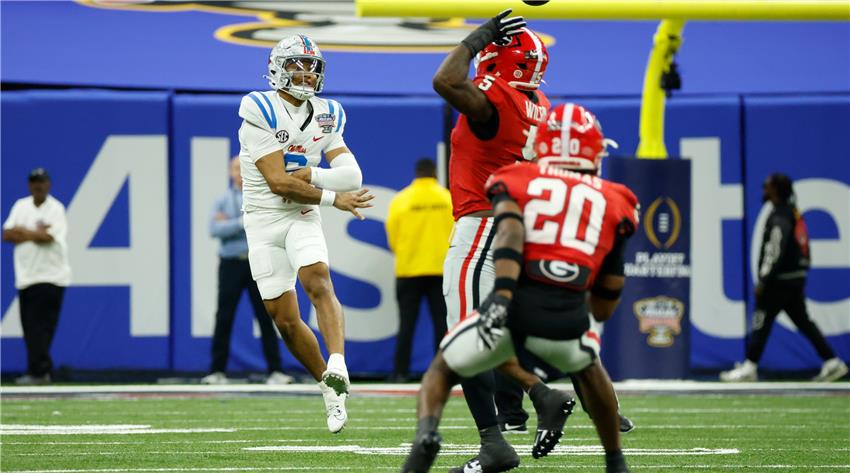
Lane Kiffin's controversial departure to LSU before the playoff raised legitimate questions about Ole Miss's ability to compete without its offensive mastermind. Interim coach Pete Golding answered those doubts emphatically in New Orleans, as the Rebels racked up 473 yards against Georgia's stout defense and erased a nine-point halftime deficit with 20 fourth-quarter points.
Quarterback Trinidad Chambliss announced his arrival on the national stage with a 362-yard passing performance that featured two touchdowns and several highlight-reel scrambles. His dual-threat ability proved impossible for Georgia's defense to contain, as Chambliss consistently extended plays and delivered strikes downfield when the Bulldogs collapsed the pocket. For a team losing its head coach mid-season, finding this kind of performance from the quarterback position represents an organizational triumph.
Chambliss's escapability will be tested against Miami's ferocious pass rush in the semifinal, but his performance against Georgia suggests he possesses the tools to survive. Through the first three quarters of the Sugar Bowl, Georgia generated just four pressures and no sacks despite frequent blitzing. When the Dawgs finally broke through in the fourth quarter, Chambliss shrugged off pressure to deliver three consecutive clutch throws, including a 44-yard completion that set up a touchdown.
The Ole Miss receiving corps found consistent separation all night, with two different Rebels topping 120 receiving yards. Harrison Wallace III emerged as the primary target, hauling in the 44-yard bomb and a 13-yard touchdown that extended the Ole Miss lead. Running back Kewan Lacy battled through a shoulder injury to contribute 98 rushing yards and two touchdowns, demonstrating the kind of toughness that elevates draft stock during evaluation season.
Suntarine Perkins delivered one of the game's pivotal defensive plays, sacking Gunner Stockton on fourth-and-2 deep in Georgia territory and recovering the fumble. The strip-sack swung win probability by nearly 20 points and effectively ended Georgia's comeback hopes. Perkins' timing and instincts on the play showcased the football intelligence NFL teams covet in modern linebackers.
Kicker Lucas Carneiro earned hero status with three clutch field goals, including the game-winning 47-yarder with six seconds remaining. A 40-yard bomb from Chambliss to De'Zhaun Stribling set up the decisive kick, capping a night that produced more win probability swings than any other quarterfinal contest.
Oregon's Defense Delivers Historic Shutout Against Texas Tech
Coach Dan Lanning challenged his defense after surrendering 500 yards to James Madison in the first round, and the Ducks responded with their first bowl shutout since World War I. Oregon limited Texas Tech to just 215 total yards, forced four turnovers, and added three turnovers on downs for good measure. The Red Raiders' prolific offense never found traction against a unit that played with championship-level intensity.
Matayo Uiagalelei changed the game with a strip-sack of Behren Morton that he recovered himself and returned to the Tech 6-yard line. The play shifted Oregon's win probability from 70.2% to 85.9% and set up the first of two short Jordon Davison touchdown runs. Uiagalelei's combination of length, athleticism, and motor has made him one of the most intriguing edge prospects in the country, and his Orange Bowl performance only enhanced his draft stock.
Freshman cornerback Brandon Finney Jr. stole the show with two interceptions and a fumble recovery, demonstrating ballhawking instincts that belie his age. Morton's decision-making deteriorated as Oregon's pressure mounted, and Finney punished every poor throw. His second interception came on a ball thrown into double coverage, showcasing the awareness and positioning that NFL scouts prize in coverage defenders.
Teitum Tuioti continued his dominant second-half surge with multiple tackles for loss and constant pressure from the edge. Tuioti has recorded seven sacks over the past six games, emerging as a legitimate NFL prospect who complements Uiagalelei's explosive athleticism with relentless effort and technique.
Texas Tech's defensive front lived up to its billing despite the lopsided final score. Edge rusher David Bailey recorded two tackles for loss (including a sack), two pass breakups, and constant disruption. Defensive tackle Lee Hunter added two tackles for loss, while linebacker Ben Roberts intercepted his third pass in two games and finished with 16 tackles. Jacob Rodriguez contributed 11 tackles in what was likely his final collegiate game.
The Red Raiders held Oregon to just 3.8 yards per play, proving their defensive investment paid dividends even in defeat. But Morton entered with the lowest Total QBR of any quarterfinal quarterback, and the Tech offense couldn't generate anything against Oregon's aggressive scheme. Joey McGuire's program made history with its first outright conference title since 1955 and its first playoff appearance, but the Orange Bowl exposed the gap between Big 12 champions and national championship contenders.
Indiana Dominates Alabama to Continue Historic Season
The Hoosiers played like the No. 1 team in the country because they are the No. 1 team in the country. Curt Cignetti's squad dominated Alabama in all phases during a 38-3 Rose Bowl victory that silenced any remaining skepticism about Indiana's legitimacy. Heisman winner Fernando Mendoza orchestrated six scoring drives after an initial three-and-out, while the defense held the Crimson Tide scoreless until garbage time in the third quarter.
Mendoza demonstrated the poise and precision that earned him college football's highest individual honor. After getting sacked on two of his first three plays, the Cal transfer settled into rhythm and picked apart Alabama's secondary with surgical efficiency. He connected with Charlie Becker for a 21-yard touchdown, hit Omar Cooper Jr. for another score before halftime, and found Elijah Sarratt to cap a methodical third-quarter drive. By the time backup Alberto Mendoza entered, the game had been decided for quarters.
Indiana's ground attack proved equally devastating. Running backs Kaelon Black and Roman Hemby combined for 188 rushing yards, consistently moving the chains and keeping Alabama's defense on its heels. The Hoosiers' offensive line imposed its will against a Crimson Tide front that couldn't generate consistent pressure, allowing Mendoza time to survey the field and his backs room to operate.
The defensive performance was equally comprehensive. Ty Simpson had to check down constantly because of pressure and excellent coverage, completing 12 passes for just 67 yards before leaving with an injury. Alabama's rushing attack, which entered the postseason ranked 117th nationally, generated just 15 yards on eight carries. The Hoosiers stuffed two fourth-down attempts and forced turnovers when Alabama tried to generate momentum.
Deontae Lawson battled admirably for Alabama but couldn't stem the tide. The senior linebacker projects as one of the Crimson Tide's top draft prospects, but this game showcased Indiana's ability to neutralize even quality defenders through schematic advantage and superior execution.
Semifinal Preview: Physicality Meets Explosiveness in Historic Matchups
The Vrbo Fiesta Bowl features a fascinating contrast in styles. Miami's game-wrecking defensive front against Ole Miss's dynamic quarterback and explosive playmakers presents evaluation opportunities at every position. Bain and Mesidor will try to disrupt Chambliss's rhythm, while the Rebels' receivers attempt to create separation against an opportunistic Hurricanes secondary.
For Miami, sustaining the physical style that overwhelmed Texas A&M and Ohio State remains paramount. The Hurricanes may need to score four touchdowns to defeat Ole Miss's high-powered attack, a threshold they haven't reached during this postseason run. Beck's game management and the ground attack's effectiveness will determine whether Miami can control tempo against a team built to score quickly.
Ole Miss must prove it can protect Chambliss against elite pass rushers. Georgia's front seven couldn't consistently pressure the quarterback, but Miami's edge tandem represents a significant upgrade in pure rushing ability. If Chambliss can escape and extend plays as he did against the Bulldogs, the Rebels possess the weapons to win a shootout. If not, this game could mirror Miami's defensive masterpiece against Ohio State.
The Chick-fil-A Peach Bowl offers something equally rare: a championship-level rematch. Indiana defeated Oregon 30-20 in Eugene on October 11th despite Mendoza throwing a pick-six early in the fourth quarter. The Hoosiers outgained the Ducks by 59 yards, controlled the second half, and demonstrated the resilience that has defined their historic season.
Oregon's offense must find answers it couldn't produce in the first meeting. The Ducks managed just 4.2 yards per play against Indiana and haven't solved elite defenses throughout 2025. Against Texas Tech, they averaged only 3.8 yards per play despite the shutout victory. If Indiana's defense performs at its Rose Bowl level, Oregon will need to manufacture points through turnovers and short fields.
The Ducks' advantage lies in their defensive improvement. Lanning's unit looked transformed against Texas Tech, and players like Uiagalelei, Finney, and Dillon Thieneman have elevated their games at the perfect time. Forcing Mendoza into turnovers represents Oregon's most realistic path to victory, though the Heisman winner has proved remarkably resilient when facing adversity this season.
NFL Draft Implications Across the Final Four
These semifinal games represent final opportunities for prospects to enhance or cement their draft positions. Bain and Mesidor have already established themselves as legitimate first-round candidates at edge rusher, but dominant performances against Ole Miss would solidify their status. Uiagalelei's physical tools place him in similar territory, with the Peach Bowl offering a chance to outperform his October showing against Indiana.
Mendoza's Heisman campaign has answered questions about his NFL readiness, but another masterful performance against Oregon would remove any lingering doubts. His combination of accuracy, poise, and clutch playmaking mirrors what NFL teams seek in franchise quarterbacks. Sarratt and Cooper have emerged as legitimate receiving prospects alongside him, with both demonstrating the route-running and hands that translate to the professional level.
Chambliss represents an intriguing evaluation challenge. His athleticism and improvisational ability create obvious appeal, but the small sample size of elite competition leaves questions unanswered. A strong semifinal performance against Miami's defense would dramatically enhance his draft stock, while struggles could relegate him to later-round consideration.
Defensively, Oregon's secondary and Alabama's departing class offer the deepest talent pools. Finney's emergence complicates the Ducks' future cornerback picture but provides NFL teams with a tantalizing prospect. For Alabama, the Rose Bowl loss may have been Lawson's final collegiate game, along with several offensive linemen considering the draft including Kadyn Proctor and Parker Brailsford.
What's Next for Eliminated Teams
The transfer portal opened immediately after the quarterfinals, forcing eliminated programs to shift focus instantaneously. Ohio State faces the second straight offseason of coordinator replacement, with Brian Hartline departing for the South Florida head coaching job. The Buckeyes return significant talent including Sayin, running back Bo Jackson, and star receiver Jeremiah Smith, but their offensive line struggled against both Indiana and Miami in back-to-back defeats.
Georgia's young core should return largely intact for Kirby Smart's next championship push. Quarterback Gunner Stockton, tailback Nate Frazier, and several defensive standouts have eligibility remaining, though linebacker CJ Allen, defensive tackle Christen Miller, and cornerback Daylen Everette project as departures. Retaining offensive tackles Monroe Freeling and Earnest Greene III becomes paramount for the Bulldogs' 2026 prospects.
Alabama must address its rushing attack after ranking 117th nationally this season. Coach Kalen DeBoer elevated the Crimson Tide back to the playoff in his second season but the Rose Bowl exposed the gap between this roster and championship-caliber competition. The portal offers opportunities to supplement what should be another strong recruiting class, with quarterback depth potentially needing attention depending on Simpson's draft decision.
Texas Tech achieved historic success under Joey McGuire but faces significant roster turnover. Brendan Sorsby, the Cincinnati transfer quarterback, represents the Red Raiders' top portal target as they attempt to replace Morton. The defensive line that carried this team to a Big 12 title will need reconstruction through another expensive transfer shopping spree.
The Path to the National Championship
Four teams remain, and none has won a national title in this millennium. Miami last claimed the crown in 2001, Oregon has never won one, and neither Indiana nor Ole Miss has ever reached college football's mountaintop. The lower half of this bracket guarantees either the Hurricanes (seeking their first title in 24 years) or the Rebels (seeking their first in 63 years) will play for everything.
Indiana's pursuit of perfection continues in Atlanta. The Hoosiers have answered every challenge this season, from surviving at Iowa and Penn State to dominating Ohio State and Alabama in consecutive games. Mendoza's ability to overcome adversity, combined with a defense that limits mistakes and forces turnovers, has created the most complete team in college football.
Oregon possesses the defensive firepower to match anyone but must prove its offense can function against elite competition. The Ducks haven't scored an offensive touchdown in 50 consecutive minutes against Indiana across two meetings. Breaking that drought requires creative solutions from Lanning and coordinator Will Stein.
The semifinal weekend will determine which two teams earn the right to play for the national championship. For NFL scouts, it represents the final showcase before evaluation season intensifies. For college football fans, it offers four programs chasing history against opponents equally motivated by the opportunity of a lifetime.
Miami and Ole Miss square off Thursday night in Glendale. Indiana and Oregon follow Friday in Atlanta. One week later, we'll know which two teams will play for the 2025 national championship. Given everything we've witnessed this postseason, predicting how it unfolds feels like folly. But that unpredictability is precisely what makes this expanded playoff so compelling.