
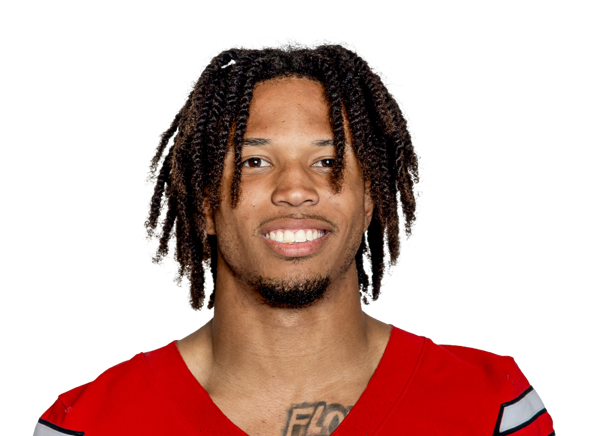
Reggie Virgil WR Texas Tech |
NFL Draft Profile & Scouting Report
| Jersey: #1 ROLE: Outside X-Receiver | ||||||||||||||||||||||||||||||
| Last Updated: 02/20/2026 | ||||||||||||||||||||||||||||||
| Draft Year: 2026 | ||||||||||||||||||||||||||||||
| FORTY time: 4.57 seconds (26%*) | ||||||||||||||||||||||||||||||
|
||||||||||||||||||||||||||||||
| Jersey: #1 | |
| ROLE: Outside X-Receiver | |
| Last Updated: 02/20/2026 | |
| Draft Year: 2026 | |
| Forty time: 4.57 seconds (26%*) | |
| Overall Rating: | 82.0 / 100 | |
|---|---|---|
| Average rating of opposition Defense player has faced | ||
| Defense Rating: |
|
77% |
| Click the links below to view how player ranks vs other prospects. | ||
| QB Rating When targeted: | 100.9 | |
| Hands: |
|
65% |
| Short Receiving: |
|
70% |
| Intermediate Routes: |
|
80% |
| Deep Threat: |
|
78% |
| Blocking: |
|
63% |
|
DRAFT PROJECTION:
5th
Overall Rank:
#169
Position rank:
#25 (WR)
|
||
| College Games: 42 College Snaps: 1620 | ||
| Player Comparison* (Similarity level) | ||
|---|---|---|
| Nick Nash - San Jose State |
|
92% |
| Tory Horton - Colorado State |
|
83% |
| Sage Surratt - Wake Forest |
|
81% |
 Drafted: ROUND: 5 - Pick Number: 143 (ARI)
Draft Profile: Bio
Reggie Virgil grew up in Apopka, Florida, and played both ways at Mount Dora Christian Academy. As a senior, he put together a monster season with 44 catches for 873 yards and 12 receiving touchdowns while also contributing five rushing scores and a pick-six on defense. He added 22 tackles and four interceptions as a junior. The two-time team captain was a three-star recruit ranked as an "athlete" by most services, and he landed at Miami (OH) in the 2022 class.Virgil's first two years in Oxford were quiet. He caught one pass each season, spending most of his time on special teams and learning the position. Then in 2024, everything clicked. He led the Redhawks with 816 receiving yards and nine touchdowns on just 41 catches, averaging a gaudy 19.9 yards per reception and earning second-team All-MAC honors. His seven-game touchdown streak included scores of 75, 69, 58, and 34 yards. That junior tape was the calling card that drew serious Power 4 interest when he entered the portal, and he picked Texas Tech over a dozen-plus programs including Michigan, Penn State, Oklahoma, and Miami (FL). ESPN ranked him the 47th overall transfer and 10th among wide receivers.
Moving from the MAC to the Big 12 was a real litmus test, and Virgil held up. He led the Red Raiders with 55 receptions while adding 676 yards and six receiving touchdowns plus two rushing scores during a season that included a Big 12 Championship victory over BYU and a College Football Playoff berth. He eclipsed 1,000 and then 1,500 career receiving yards during the 2025 campaign, earned All-Big 12 Honorable Mention, and picked up an invite to the Senior Bowl. He finished his college career with 100 catches, 1,583 yards, and 16 touchdowns across 42 games played at both schools.
Scouting Report: Strengths
- Uses quick feet and subtle body fakes at the line to slip past press coverage, rarely getting stuck or rerouted at the snap.
- Excellent deep-ball tracking ability lets him adjust his angle and timing on throws over his shoulder without breaking stride.
- Catch radius is enormous thanks to 6'3" length; he plucks the ball confidently outside his frame and high-points throws above traffic.
- Savvy route seller who disguises his intentions well, making verticals and intermediate breaks look identical through the stem.
- Legitimate speed forces corners to respect the deep ball, which opens up shorter routes and gives him free access underneath.
- Finds the soft spots in zone coverage with real feel for spacing, settling in windows rather than drifting through them.
- Works back to the quarterback aggressively on comebacks and curls, closing the window for defenders to jump the throw.
- Showed he can perform against better competition by maintaining production after jumping from the MAC to the Big 12 in one offseason.
Scouting Report: Weaknesses
- Built like a beanpole at 190 pounds; his thin frame limits his ability to fight through physical corners and survive contact as a runner.
- Contested catch production is underwhelming for his size, with defenders getting hands on too many of his targets in traffic.
- Focus drops pop up more than you want to see; nine on 100 career catches is a number that will concern evaluators.
- Route breaks can get rounded and loose, with too much drift upfield that gives defenders time to recover to the ball.
- Run blocking is more effort than execution; he is willing to get in the way but lacks the functional strength to sustain or drive blocks.
Scouting Report: Summary
What you see with Virgil is a tall, fast receiver who can threaten a defense vertically and give a quarterback a reliable target on intermediate routes. The deep ball was his bread and butter at Miami (OH), where he averaged nearly 20 yards per catch, and while that number dipped in the Big 12, his overall game got more well-rounded. He handled a broader route tree at Texas Tech, showed he could win from the boundary consistently, and proved that his MAC production was not a product of weak competition. That said, his graded production stayed in average territory across both stops, and his receiving numbers at Tech suggest a player who was solid rather than dominant against upper-tier defensive backs.The elephant in the room is that frame. At 190 pounds on a 6'3" build, he is going to get pushed around by NFL corners who play with physicality, and his contested catch numbers back that up. He has the speed and body control to win when he has a step, but winning at the catch point against press-man coverage in tight windows is a different story. His drop rate is another flag. Those are traits that can be partially addressed with added strength and continued technical refinement, but the margin for error is slim for a receiver who does not profile as a separator with elite burst or wiggle after the catch.
Virgil fits best in an offense that values speed on the outside and can scheme him into one-on-one opportunities down the field. He has the tools to be a legitimate deep threat at the next level, and his route-running foundation is better than most Day Three receivers. In a system that lets him work as a primary boundary receiver with complementary intermediate targets mixed in, he can carve out a role as a fourth or fifth receiver who keeps defenses honest with his vertical ability. Special teams experience on multiple units adds further value. He has a real chance to stick on a roster, but his ceiling depends heavily on whether his body can hold up to the physical demands of the NFL.
Reggie Virgil percentiles vs other Wide Receivers (NFL Combine historically - higher value represents better perfomance)
How other scouting services rate Reggie Virgil (Overall Rank)
All Scouts AverageOverall Rank
145.0
All Scouts AveragePosition Rank
27.0
*Percentile Ranking in Player's Position Group (NFL Combine Historical Data): This percentile reflects how a player's specific statistics rank
in comparison to historical performances at the NFL Combine, specifically within their position group. A higher percentile indicates a better performance.
For instance, being in the 90th percentile for a particular stat means the player outperformed 90% of their peers in that category.
*Similarity Percentage: This percentage is calculated based on a comprehensive analysis of various factors, including height, weight, 40-yard dash times, on-field performance statistics, and overall player rating. The analysis is conducted against our database of draft prospects from 2021 to 2023. This similarity score helps in evaluating how closely a current prospect aligns with past prospects. It is important to note, however, that this score reflects similarities based on college production and attributes, and does not account for eventual success or performance in the NFL.
*Similarity Percentage: This percentage is calculated based on a comprehensive analysis of various factors, including height, weight, 40-yard dash times, on-field performance statistics, and overall player rating. The analysis is conducted against our database of draft prospects from 2021 to 2023. This similarity score helps in evaluating how closely a current prospect aligns with past prospects. It is important to note, however, that this score reflects similarities based on college production and attributes, and does not account for eventual success or performance in the NFL.