
We Ran the Season Again After Week 1. Buffalo Is Back. The Rams Never Left.
In July we played the 2026 NFL season one hundred times and published what came back. Then the real thing started. San Francisco beat the Rams by twenty in Melbourne. Chicago scored 59 in Carolina. Baltimore hung 41 on the Colts. Seattle, Atlanta and Minnesota all finished Week 1 with a different quarterback than the one they started it with. So we did the only sensible thing and ran it again.
Not from scratch. The fifteen games that have been played are in the books, every snap of them, and every player's Week 1 stats now sit alongside his 2025 grades. The remaining sixteen weeks and the postseason were then played out two hundred times, twice the July run, with the injury list as it actually stands. What came back is a league that moved a long way in one weekend, and one team that did not move at all.
What went in this time
The engine is the same one. Every player is graded per snap on what he actually did, aged along a career curve, and dropped onto his real roster against the real schedule. Two things are different now. The Week 1 numbers are seeded into every player's line, so a receiver who caught ten balls for 182 in Detroit carries that into the rest of the season, and the depth charts reflect who is actually available. Micah Parsons is on the physically unable to perform list until at least mid-October. Myles Garrett had knee surgery after Melbourne and is on injured reserve for four games. A.J. Brown is on injured reserve with an ankle. Josh Jacobs is on the commissioner's exempt list. Aaron Donald, remarkably, is back from two years of retirement and makes his debut in Week 2.
None of that is narrative. It is who is on the field, and the model prices who is on the field. Where the answers moved, they moved because of a result, a stat line or a name on an injury report, and we have said which in every team preview.
The model's Week 1 scorecard
Before the standings, the honest bit. Our matchup projections picked a favorite in all fifteen games played so far and got seven of them right. That is a coin flip, and the misses were loud ones. We had the Rams at 90 percent over San Francisco, Houston at 84 percent over Buffalo, Indianapolis at 70 percent over Baltimore and the Chargers at 80 percent over Arizona, and all four favorites lost. Week 1 is the week the league is least like the season before it, which is exactly why the model gets re-run rather than left alone. The projections below are the re-run.
LA is still LA
The Rams lost by twenty on the other side of the world, watched Matthew Stafford complete four passes in a half, and then lost the best pass rusher alive for a month. It was the worst week a contender can have without losing its quarterback. And when we ran the rest of the season, Los Angeles still came out at 14-3, still a 100 percent playoff team, and still a 44 percent shot at the title, a number no other club is within thirty points of.
The record dropped one win. Nothing else moved. The offense still projects to lead the league in scoring by a distance, with Stafford at 4,711 yards and 33 touchdowns, Puka Nacua at 120 catches for 1,599 yards and Davante Adams at 86 for 1,238. The defense, even without Garrett until October, still grades fourth in points allowed and first in yards, because Donald is back inside and Byron Young and Kamren Curl are still there. Melbourne was a warning. The model does not treat it as a verdict.
The AFC got a new shape
In July the AFC looked like Cincinnati and Denver at the top with Houston running the South. One week later it is Denver, Jacksonville, Cincinnati and Baltimore, with Houston a step behind, and two of those names are the story of the re-run.
Jacksonville beat Cleveland 34-10 with Trevor Lawrence throwing four touchdowns on 23 attempts, and Houston and Indianapolis both lost at home the same weekend. The Jaguars jumped from ten wins to 12-5, the defense now grades third in points allowed and second in sacks, and when we ran the rest of the season Jacksonville finished with one of the two or three best records in the conference. In July we called them a mild over. That flag is now on the size of the move rather than the direction.
Baltimore was the July preview we said we would double check, a nine-win projection on a roster with Lamar Jackson and Derrick Henry that did not add up. Then the Ravens scored 41 in Indianapolis, Henry ran for 144 and three scores, and the offense our model had graded 23rd stopped being graded 23rd. Baltimore now projects for 11-6 with the second-best scoring defense in football, and the AFC North is a two-team race with Cincinnati rather than a Bengals procession.
Denver has not played a snap. Its title odds still doubled to eight and a half percent, the best number in the AFC, because Cincinnati's division got harder and Houston lost at home while the Broncos watched. Monday night against Kansas City is the first look at a roster our model has been calling the most complete in the conference since July.
The biggest move in the league is in Buffalo
Our boldest July call was Buffalo at five wins, an elite offense bolted onto a defense that had lost nine of its top sixteen snap-takers. Then the Bills went to Houston, gave up 31 points, and won 36-31 anyway, with Josh Allen throwing for 334 and Greg Rousseau forcing two fumbles. When we re-ran the season, Buffalo climbed from 5-12 to 8-9, the largest move of any team in the league.
Read the fine print before celebrating in Orchard Park. The defense went from a projected 500 points allowed, last in the league by a margin, to 416, which is 29th. It moved from catastrophic to merely bad, and with this offense that is worth three wins. It is not worth the ten and a half the market opened at, and the model still sits two under it. The AFC East, meanwhile, is now three teams within a win of each other, with the Jets at 9-8 on the strength of a top-six defense and New England at 8-9 after losing A.J. Brown and throwing three interceptions in Seattle.
Where the arguments moved
San Francisco was a hard fade in July, a roster full of famous names and a defense graded 30th. Then the 49ers held the best offense in football to seven points and the model moved them from 7-10 to 9-8, a coin flip for the playoffs. The defense now grades middle of the pack rather than bottom five. One game does not make a defense, and the preview says so, but the size of the disagreement with the market went from three and a half wins to one.
Atlanta was the model's bet on Michael Penix Jr. taking a leap. In Week 1 he was inactive with a knee, Tua Tagovailoa was out with an oblique, and Cooper Rush started in Pittsburgh and threw a pick-six to T.J. Watt. The Falcons dropped from eleven wins to 10-7, and the projection is now conditional on a medical report rather than a development curve. Bijan Robinson, who touched the ball 29 times for 173 yards with a third-string quarterback, is the reason it did not fall further.
Tampa Bay stayed exactly where it was at five wins, and the opener was the projection in miniature: Baker Mayfield went 23 of 28 for 216 yards without a touchdown pass, the offense scored 27 anyway, and the defense gave up 33. Green Bay, with Parsons and Jacobs both unavailable, fell from ten wins to 8-9 after losing to a Minnesota team playing Carson Wentz. Dallas fell from eleven wins to 9-8 after losing in New York without Tyler Smith, who is out four to six weeks. Indianapolis, the July result we told you to double check, dropped from eleven wins to 9-8 after Baltimore's 41, and the caution light has been replaced with a plain reading of the standings.
Chicago went the other way. Fifty-nine points in Carolina moved the Bears from 8-9 to 9-8 and the offense from ninth to fifth in projected scoring. Arizona won in Los Angeles and moved from four wins to six. Las Vegas beat Miami without Brock Bowers and moved from six to seven, on the strength of a pass rush that suddenly has Kwity Paye next to Maxx Crosby.
What did not move, and why
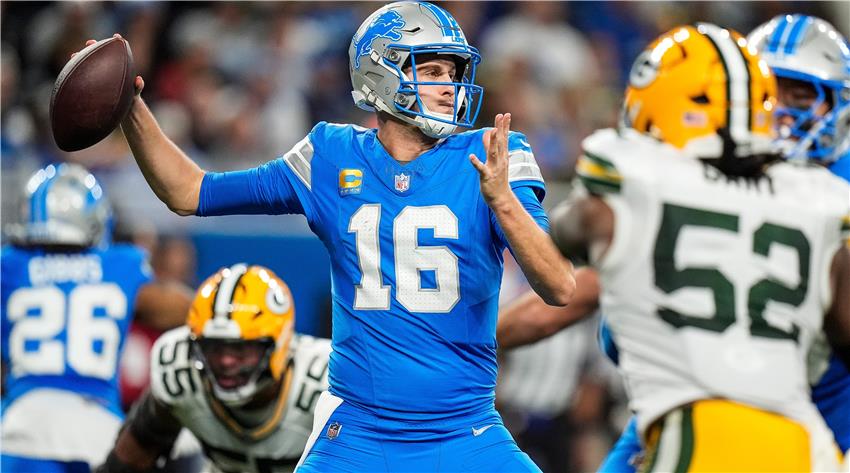
Detroit is still 13-4 and still the second-best title shot in football, though a defense that gave up 30 to New Orleans in overtime now grades tenth rather than second. Philadelphia beat Washington by two and climbed to 12-5 behind a defense that now grades first in the league in points allowed. Seattle lost Sam Darnold on the opening drive, beat New England with Drew Lock, and held at 11-6 because the defense intercepted Drake Maye three times. Cincinnati needed 33 to beat Tampa Bay and held at 12-5, which is what a Cincinnati win usually looks like.
Minnesota beat Green Bay by 17 and stayed at six wins, which will annoy Vikings fans and deserves the straight explanation the preview gives it: the win is banked, the roster grades did not move, and the rest of the division got better in the same weekend. Kansas City has not kicked off and already dropped from eight wins to seven and a half, for the same reason. The Chiefs did not get worse. Everyone around them got better.
Building for later
Cleveland scored ten in Jacksonville and now projects for 3-14 with the lowest-scoring offense in football by 23 points. Tennessee scored ten against the Jets and also projects for 3-14. Washington took the Eagles to the wire and earned half a win for it, to 4-12. The Giants beat Dallas with Jaxson Dart throwing three touchdowns in his first start, and while the model moved him from a rookie taking his lumps to a competent starter with upside, the defense still grades 30th and the record still reads 5-12. Miami lost in Las Vegas and slid to 6-11, which is roughly where the market had the Dolphins all along.
Go argue with it again
The philosophy has not changed. The model does not care who won last year or who the experts liked in August. It cares about the talent on the field, the ages of the players carrying it, who is actually available, and the schedule ahead. The difference now is that it also cares about what happened on Sunday, and it will keep caring every week from here to January.
Every one of the 32 team previews has been rewritten for the re-run: the new projected record against the July one, playoff and Super Bowl odds, the Week 1 box score, the players our model has climbing or falling, and what the next month of schedule looks like by our numbers. Start with the full 2026 league projection, standings and odds, then go find out whether one week was enough to change your mind about your team, or whether the machine is still the one that needs convincing.
All 32 team previews
AFC East
Buffalo Bills
Miami Dolphins
New England Patriots
New York Jets
AFC North
Baltimore Ravens
Cincinnati Bengals
Cleveland Browns
Pittsburgh Steelers
AFC South
Houston Texans
Indianapolis Colts
Jacksonville Jaguars
Tennessee Titans
AFC West
Denver Broncos
Kansas City Chiefs
Las Vegas Raiders
Los Angeles Chargers
NFC East
Dallas Cowboys
New York Giants
Philadelphia Eagles
Washington Commanders
NFC North
Chicago Bears
Detroit Lions
Green Bay Packers
Minnesota Vikings
NFC South
Atlanta Falcons
Carolina Panthers
New Orleans Saints
Tampa Bay Buccaneers
NFC West
Arizona Cardinals
Los Angeles Rams
San Francisco 49ers
Seattle Seahawks