
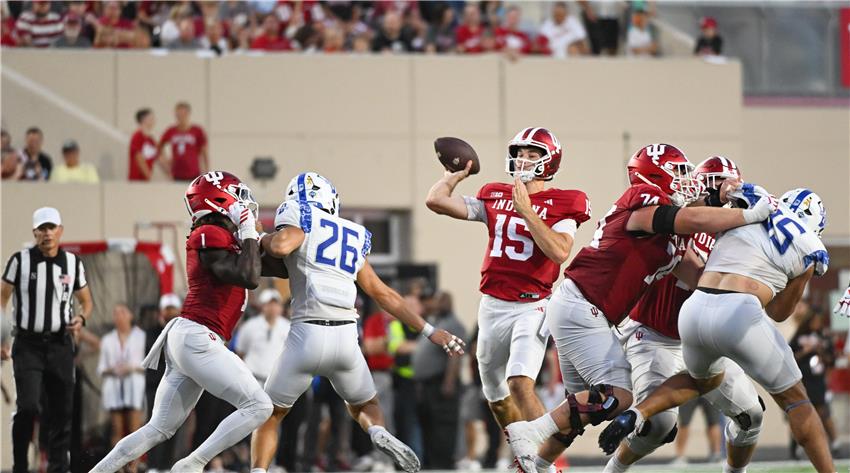
Mendoza vs. The Big Board: Why Draft Rankings Diverge
Fernando Mendoza is QB1 on most boards but not all. Here's why draft analytics models disagree, and what the split means for teams building draft strategy.
Fernando Mendoza vs. The Big Board: Why Scouts and Aggregators Can't Agree on Who's QB1
Fernando Mendoza threw for a Heisman-caliber season at Indiana and walked into the 2026 cycle as the presumptive QB1. ESPN has him there. CBS Sports has him there. NCAA.com built an entire piece around how rare it is for a Heisman-winning quarterback to also go No. 1 overall, and Mendoza fits that mold about as cleanly as anyone since the last true two-way lock.
Then you open Tankathon.
Mendoza sits fourth. Behind three defenders. Not because anyone thinks he can't play quarterback at the next level, but because the model underneath Tankathon's board weighs positional scarcity and projected value differently than a scout sitting in a film room in Bloomington. That gap, QB1 on one board and QB4 on another, is not a rounding error. It is the entire ballgame for how modern draft evaluation actually works, and it says a lot about why teams building draft boards in 2026 are leaning on more inputs than ever.
Why the Models Disagree More Than the Scouts Do
Here's the thing people miss. Scouts mostly agree on Mendoza. Watch the tape from Indiana's 11-win season and you'll see the anticipation throws, the pocket movement, the arm talent that made him a Heisman finalist. ESPN's scouting breakdown and PFF's data-driven grading land in mostly the same place on the player himself. The disagreement isn't about Mendoza's ceiling. It's about what a board is even supposed to measure.
Tankathon and similar aggregator models often build the big board as a value-over-scarcity exercise, not a pure talent ranking. A quarterback in a shallow QB class gets a bump. A pass rusher in a historically deep defensive class might actually get docked. Add three elite defenders into the same draft cycle and suddenly a model that rewards positional rarity can bury a QB1 behind players a scout would never rank above him one-on-one.
This is exactly the kind of disagreement that shows up in prospect futures markets months before the draft ever happens. Odds on who goes No. 1 overall move constantly as boards shift, and for readers trying to track how sportsbooks price that uncertainty, it helps to see the full guide on how these markets track shifting consensus versus contrarian rankings. Futures pricing on draft order tends to move with ESPN and CBS Sports first, and lag behind more analytics-driven boards like Tankathon by a week or two, which tells you something about which inputs the market actually trusts.
Gambling involves risk. Only wager what you can afford to lose, and visit BeGambleAware.org if it stops being fun.
What the Split Actually Tells Front Offices
Front offices don't build their boards off a single aggregator, obviously. But the public disagreement between consensus rankings and model-driven boards is a decent proxy for something real happening inside war rooms right now. A team drafting in the top five in 2027 isn't just asking "is Mendoza good." They're asking whether their scarcity model should override their pure talent grade when a draft class is this deep on defense.
NBC Sports' Chris Simms ranked Mendoza as his QB1 too, for what it's worth, and his commentary leaned heavily on pocket presence and processing speed rather than scheme fit. That's a scout's argument. It's built on watching a guy play, not on running his measurables against a positional value curve.
Compare that to how CBS Sports' own prospect model reached its own No. 1 conclusion. Different inputs, similar output, but the reasoning underneath diverges more than the final ranking suggests. That's the trap with big board consensus. Two sources can agree on QB1 for completely different reasons, and when a third source disagrees, it's not obvious whose logic actually holds up.
The 2027 Class Makes This Argument Louder
None of this stays contained to 2026. ESPN's early top-five-by-position breakdown for the 2027 class already has evaluators split on how to weigh a defensive-heavy class against a thinner quarterback crop. Three quarterbacks already project into the top five of next year's board, per early CBS Sports projections, and the same scarcity-versus-talent argument that buried Mendoza on Tankathon's model is going to resurface for whichever QB1 emerges from that group.
Teams picking early in future cycles are watching this play out in real time. A quarterback-needy franchise that leans too hard on a consensus board risks overpaying for scarcity. One that leans too hard on a pure talent grade risks reaching. Neither approach is wrong. They're just measuring different things, and the Mendoza split is the cleanest public example of that tension in years.
Worth noting, too: not every disagreement is about the quarterback position specifically. Watch how a player like Kyle Louis gets valued across different boards this cycle. Linebackers in a deep defensive class tend to see the widest swings between scout-driven and model-driven rankings, for the exact same scarcity reasons driving the Mendoza gap.
Where This Leaves Teams Building Their Own Board
If you're a front office (or just someone trying to build a personal big board that isn't garbage), the takeaway isn't "trust ESPN over Tankathon" or vice versa. It's that no single aggregator should be your only input. Bleacher Report's scouting take on Mendoza, detailed here, leans closer to the consensus QB1 view but flags accuracy on rollout throws as a real weakness nobody else mentions as prominently. That's a data point the aggregator models don't capture well because it's qualitative, not something you can cleanly plug into a value curve.
The smartest draft rooms this cycle are running multiple models in parallel and treating disagreements between them as flags for deeper film study, not as noise to average out. When Tankathon and the consensus board disagree by three spots, that's probably just model variance. When they disagree by four positions and a full tier, like they do here, that's a signal worth actually investigating before the pick gets made.
Mendoza will likely still hear his name called near the top of the 2027 board conversation continues to build around him. But the fact that a Heisman-winning, consensus QB1 quarterback can simultaneously rank fourth on a respected model tells you the big board, as an industry concept, has quietly split into two different tools that happen to share a name.
FAQ
Why does Tankathon rank Mendoza behind three defenders when most boards have him at QB1? Tankathon's model weighs positional scarcity more heavily than pure talent grading. With three elite defensive prospects in the same class, the model rewards their rarity even though most scouts still view Mendoza as the better overall player at his position.
Is Fernando Mendoza actually the best quarterback in the 2026 class? Most scouting reports, including ESPN and PFF, rank him QB1 based on tape. His anticipation throws and pocket movement are the separators. The debate isn't about his talent, it's about how different models value quarterback scarcity against defensive depth.
How much do aggregator disagreements actually affect where a player gets drafted? Teams rarely draft off a single public board, so the disagreement matters more for public perception and draft-order markets than actual front office decisions. Front offices build proprietary boards blending scout grades with their own scarcity models.
Does the 2027 draft class have a similar QB ranking problem? Early indications suggest yes. ESPN and CBS Sports both note a deep defensive class paired with three early top-five quarterback projections, setting up the same scarcity-versus-talent argument that's playing out with Mendoza right now.