
The 2026 NFL Scouting Combine - 318 Prospects, One Week to Change Everything
The 2026 NFL Scouting Combine is here. From Fernando Mendoza's locked-in No. 1 status to Arvell Reese's meteoric rise and Rueben Bain Jr.'s polarizing measurements, we break down the prospects, storylines, and burning questions heading into Indianapolis.
Reese, Bain and the Combine's Biggest Questions: Inside the Prospects Who Will Define the 2026 NFL Draft
The NFL Scouting Combine has always served as the great equalizer. It can validate a season's worth of dominant tape or unravel months of carefully constructed hype. As more than 300 prospects descend upon Lucas Oil Stadium in Indianapolis this week, the 2026 draft class finds itself at a fascinating crossroads. A handful of players have rocketed up boards since August, while others who entered the college football season as consensus first-rounders now find themselves scrambling to salvage their pro futures. The combine represents the next critical checkpoint in a process that will culminate in Pittsburgh on April 23-25, and for several prospects, the stakes have never been higher.
What makes this particular class so compelling is the stark contrast between its ceiling and its depth. At the top, there are legitimate franchise-altering talents. Fernando Mendoza, the Heisman Trophy winner out of Indiana, sits alone as the draft's only sure-thing quarterback. Behind him, a collection of defensive playmakers and offensive weapons have separated themselves from the pack. But drop below the first round and this class becomes a minefield of medical red flags, inconsistent tape and prospects whose positional fits remain genuinely unclear. Indianapolis will provide answers to some of those questions. For others, the mystery will only deepen.
The Mendoza Coronation: Why the Raiders Aren't Going Anywhere
If there is one certainty in this draft cycle, it is that Fernando Mendoza will hear his name called first. Executives polled across the league were unanimous in their belief that the Las Vegas Raiders will stay put at the top of the board and select the quarterback who led Indiana to a historic national championship. Not a single evaluator suggested the Raiders would entertain trading out of the pick.
The numbers alone tell a remarkable story. Mendoza's 27 red zone touchdowns without an interception led all of college football, and his 79.2 percent adjusted completion rate ranked second nationally. But it was the moments between the stats that captivated evaluators. His fourth-down touchdown run in the national championship game against Miami, a scramble-and-stretch that will live forever in title game lore, encapsulated the kind of competitor NFL teams covet. Seattle Seahawks defensive end Leonard Williams watched that game two weeks before helping his team capture the Super Bowl and came away talking not about Mendoza's arm or his legs, but about his demeanor.
The Raiders finished dead last in total offense a season ago, averaging a paltry 245.3 yards per game. Mendoza will not walk into a roster overflowing with weapons, but with nearly $88 million in salary cap space, Vegas has the resources to build around him aggressively.
Ohio State's Assembly Line Produces Another Defensive Monster
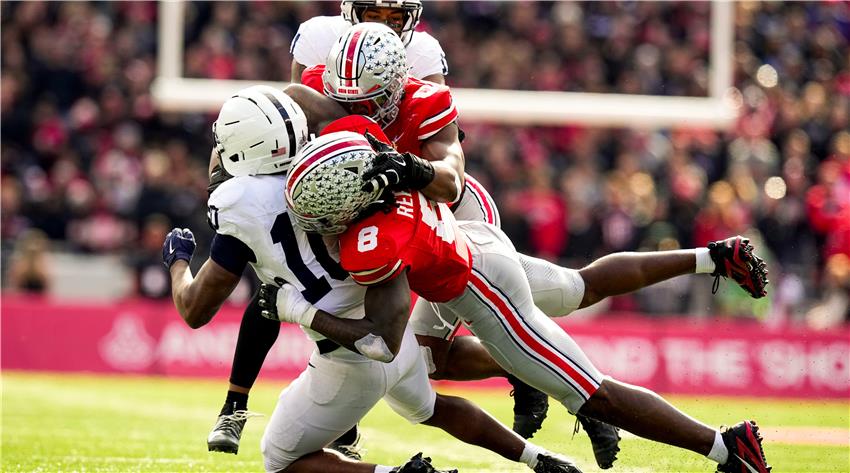
The Buckeyes have long been known as a program that reloads rather than rebuilds, and the 2026 draft class might be the most emphatic proof yet. Arvell Reese entered the 2025 season as a rotation piece behind Sonny Styles. He will leave it as potentially the first defensive player selected in April, currently graded as the sixth overall prospect and earning five votes as the best player in the class regardless of position in a league-wide poll of executives and scouts.
At 6-foot-4 and 243 pounds, Reese presents an evaluation puzzle that excites offensive coordinators and terrifies them in equal measure. Is he an off-ball linebacker with raw pass-rushing upside? A full-time edge defender? Or something entirely different, a Micah Parsons-style hybrid who can wreak havoc from multiple alignments? The answer might be all of the above. His 6.5 sacks and 10 tackles for loss as a junior showcased spectacular flashes of violence and physicality at the point of attack, and creative defensive coordinators are already dreaming about the possibilities. The reigning Big Ten Linebacker of the Year earned consensus All-American honors and demonstrated the kind of versatility that the Seattle Seahawks used to perfection in their Super Bowl-winning defensive scheme, deploying disguised overload blitzes that require exactly the type of athlete Reese has proven himself to be.
The caveat, and there is always a caveat with prospects this tantalizing, is that Reese has just one year of starting experience. Old-school evaluators will caution against selecting a player this high without a crystal-clear development plan. But the athletic testing in Indianapolis could silence those concerns entirely. If Reese's speed, agility and explosion numbers match what scouts see on tape, the conversation will shift from whether he deserves a top-five pick to whether anyone can justify passing on him.
Reese is not Ohio State's only defensive prospect generating first-round buzz. Kayden McDonald stepped into a starting role after the Buckeyes lost both Tyleik Williams and Ty Hamilton to the draft and promptly outperformed both of them. The 6-foot-3, 326-pound nose tackle led all Power Four interior defenders with an 86.5 PFF grade while posting a staggering 91.2 run-defense mark that topped the entire nation. McDonald recorded 34 defensive stops, ranking second among Power Four interior linemen. He more than doubled his reps from the previous season and flourished as a true junior, establishing himself as an immediate NFL contributor against the run with legitimate upside as an interior pass-rusher. His technique remains a work in progress, but his rare combination of size, strength and athleticism at just 20 years old makes him a prospect whose best football is clearly ahead of him.
Caleb Downs, now at Ohio State after transferring from Alabama, also garnered a vote as the best prospect in the class. The safety has been widely considered the top player at his position, though a challenger from an unlikely program has emerged to contest that throne.
Toledo's McNeil-Warren Forces the Safety Conversation Wide Open
Any small-school prospect faces an uphill battle during the evaluation process, but Emmanuel McNeil-Warren has done everything in his power to flatten that hill. The Toledo safety followed the trail blazed by former Rockets teammate Quinyon Mitchell, who has already established himself as one of the NFL's premier cornerbacks, and has carved out his own path to first-round consideration.
At 6-foot-3 and 209 pounds, McNeil-Warren possesses the size and physicality that evaluators dream about at the safety position. His junior season was cut short by injury, making his dominant senior campaign all the more critical. He delivered emphatically, stuffing the stat sheet with 77 total tackles, 5.5 tackles for loss, two interceptions, five pass breakups and three forced fumbles. Scouts have drawn comparisons to the kind of hybrid role that allowed Kyle Hamilton, Derwin James and Nick Emmanwori to thrive in their respective defensive schemes.
The combine represents a massive opportunity for McNeil-Warren. While some evaluators will inevitably pause at the level of MAC competition he faced, a standout performance on the Lucas Oil Stadium turf could push his stock firmly into the top-20 conversation. His long, rangy frame, elite ball skills and what scouts have described as a smash-boy mentality make him the kind of prospect who could test extremely well and force teams to rethink whether Caleb Downs is truly the undisputed top safety on every board.
The Receiver Race Has No Clear Winner
The battle to become the first wide receiver selected in April remains genuinely wide open, and the combine could be the tiebreaker. Makai Lemon stormed into the conversation after a breakout junior season at USC, erupting for 1,156 receiving yards and 11 touchdowns after managing just 852 yards and three scores across his first two collegiate campaigns. The Fred Biletnikoff Award winner was not even the most talked-about receiver on his own roster entering the season, as Ja'Kobi Lane carried higher expectations but failed to take the anticipated leap.
Lemon's 5-foot-11, 190-pound frame does not scream prototypical X-receiver, but his game translates perfectly as a slot weapon who terrorizes defenses after the catch. Scouts rave about his toughness, spatial awareness and tackle-breaking ability, qualities that project to an immediate NFL role as a security blanket who does all the little things to make an offense hum.
Jordyn Tyson out of Arizona State offers the more traditional WR1 profile at 6-foot-2 and 200 pounds, flashing elite ball skills and hand-eye coordination on contested catches between the hashes. His 14.7 yards per catch demonstrated legitimate big-play potential, and his size makes him difficult to bring down in the open field. The problem is durability. The 2024 season was the only one in which Tyson appeared in 10 or more games, with a series of injuries limiting his availability throughout his college career. His combine medicals could ultimately determine whether he goes in the top 10 or slides into the teens.
Carnell Tate from Ohio State currently sits as the favorite to be the first receiver drafted, and there is good reason to believe that will not change after Indianapolis. Tate is deceptively fast, with long strides that allow him to eat up ground quickly, and his 40 time could land closer to 4.4 than 4.5 seconds. Meanwhile, Zachariah Branch will look to prove he is more than a gadget player after a 2025 season heavy on screen passes. He should have no trouble running in the 4.3s, but teams want to see him track the football over his shoulder and demonstrate route-running polish during positional drills.
On the speed front, Brenen Thompson, now at Mississippi State, might be the fastest player at the entire combine. The diminutive receiver ran a 10.18-second 100 meters in high school and led the FBS with five catches of 50-plus yards in 2025. His 40 time could dip as low as 4.28 seconds. Other burners expected to challenge the sub-4.35 barrier include Barion Brown from LSU, Deion Burks from Oklahoma, Eric Rivers from Georgia Tech, Desmond Reid from Pittsburgh and Malik Benson from Oregon.
Bain's Body Type Creates a Fascinating Debate
Rueben Bain Jr. might be the most polarizing defensive prospect in the entire class, and his combine measurements could swing his draft position by 10 or more picks. The Miami edge rusher dominated during the College Football Playoff, racking up five sacks across four games to finish the season with a staggering 15.5 total. His motor never stops, his dip-and-rip move is devastatingly polished, and he plays with a relentless approach that consistently produces splash plays in the backfield.
The debate centers on his frame. Listed at 6-foot-3 and 270 pounds, Bain measures 1.4 inches shorter and 11 pounds heavier than the average edge rusher drafted in the first round over the past five years. Some evaluators see a twitchy interior rusher better suited to attacking from the three-technique spot. Others envision a blue-collar edge defender in the mold of Dante Fowler who makes his mark through sheer relentlessness and crafty counter moves. His verified height and arm length in Indianapolis will carry enormous weight.
Miami's other pass-rushing terror, Akheem Mesidor, played his way out of Bain's shadow this season and into first-round consideration of his own. But scouts are eager to see how his testing numbers stack up against his tape, and his medical evaluation will be critical given a history of foot injuries. If both Miami edge rushers test well, the Hurricanes could have two defensive linemen selected in the first 20 picks.
The Quarterback Wilderness Beyond Mendoza
After Fernando Mendoza, the quarterback landscape becomes treacherous terrain for NFL teams desperate for a signal-caller. Ty Simpson represents the most fascinating case study of the combine. He could hear his name called as early as pick 13 or slide all the way to the 53rd selection, and neither outcome would shock anyone in the scouting community.
Simpson's quick-rhythm passing, pinpoint accuracy and anticipation from a clean pocket have drawn comparisons to Baker Mayfield and Brock Purdy. But he brings just one season of starting experience, suffered a late-season swoon that included four interceptions across a four-game stretch, and managed only 67 passing yards on 16 attempts in the College Football Playoff quarterfinal before a cracked rib knocked him out. His listed 6-foot-2, 208-pound frame raises durability concerns for a mobile quarterback who creates with his legs. The combine will need to provide verified measurements, clean medicals and sharp throwing mechanics to convince a team to invest a first-round pick.
Cole Payton out of North Dakota State presents a unique case in which staying loyal to his program rather than transferring may have actually hurt his draft stock. With only one season as a starter, he is not ready to face NFL competition immediately. But at roughly 230 pounds with projected 4.5-second speed, his athletic testing could ignite serious buzz if paired with clean mechanics and accurate throwing during the quarterback workout.
The cautionary tale of Cade Klubnik looms large over this entire quarterback class. The Clemson signal-caller entered the season as a widely projected first-rounder after throwing for 3,639 yards with 463 rushing yards and 43 total touchdowns. Six months later, he barely squeezed into the top 125 prospects and is now viewed as a Day 3 option. His struggles reading the field post-snap, his over-reliance on simple reads and athleticism, and his inability to progress as expected turned what should have been a coronation into a collapse. Scouts noted that he teeters between throwing early and throwing late, and when he is late, the ball enters vulnerable windows that NFL defenders will exploit ruthlessly.
Clemson's Slide Extends Beyond the Quarterback
Klubnik's struggles were symptomatic of a broader Clemson disappointment that dragged down multiple prospects. Antonio Williams saw his production crater from 75 receptions, 904 yards and 11 touchdowns to 55 catches, 604 yards and just four scores. The 5-foot-11, 190-pound receiver lacks the explosiveness to generate big plays out of the slot, runs freelancing routes that lack precision at the break point, and has limited experience against press coverage. He profiles as a Day 2 slot option but nothing more.
Peter Woods remains one of the more intriguing defensive tackles in the class thanks to his rare combination of cat-like quickness and violent hands at 6-foot-3 and 315 pounds. But his production has never matched his traits, totaling just five sacks and 14.5 tackles for loss over 35 career games. His 2025 stat line of two sacks and 3.5 tackles for loss across 12 appearances is particularly alarming. Scouts need to determine whether Clemson's scheme suppressed his potential or whether his flashes will remain just that at the next level.
T.J. Parker saw his sack total cut nearly in half from 11 to five between 2024 and 2025, though he remains a projected first-round talent. His speed-to-power rush off the edge is formidable, and his ability to slide inside adds schematic versatility. The production dip could actually create value for whichever team drafts him, provided his combine testing confirms the athletic tools that made him a monster two seasons ago.
The Trenches Will Be Well-Stocked
The offensive line class features several prospects whose combine performances will be pivotal. Kadyn Proctor carries the most upside of any blocker in the draft, but his 6-foot-7, 366-pound frame is both his greatest asset and his biggest concern. The former five-star recruit has flashed dominant potential as a blindside protector, but sloppy footwork and shaky balance plagued him at times, issues often attributable to his weight after reportedly topping 400 pounds as a freshman. He made weight management a focus and played significantly better down the stretch in 2025, but some scouts wonder whether he might be better suited to guard at the next level.
Olaivavega Ioane from Penn State might be the safest offensive line pick in the class. The dominant left guard combines a thick, proportioned build with outstanding strength and an infectious playing temperament. His epic battle against Oregon's A'Mauri Washington in Penn State's double-overtime loss showcased the kind of competitor who will anchor an NFL interior for a decade. Evaluators compare him favorably to Steve Avila, the Rams' 2023 second-round pick who became an immediate starter.
Chase Bisontis from Texas A&M offers a well-rounded skill set at guard with impressive contact balance and consistency, though his shorter arms could limit his draft position. Emmanuel Pregnon from Oregon brings a massive frame with power through his hips and shocking hands, creating movement in the run game when he stays balanced through his blocks.
On the other end of the spectrum, Isaiah World represents the draft's most dramatic faller among offensive linemen. The Oregon tackle transferred from Nevada with sky-high expectations given his 6-foot-8, 318-pound frame and experience at both tackle spots. Instead, he was exposed against top competition, particularly during the College Football Playoff, where elite edge defenders regularly deposited him in his quarterback's lap. A torn ACL suffered during the Ducks' loss to Indiana pushed him from a projected first-rounder all the way to late Day 3 territory.
Medical Evaluations Could Reshape the First Round
Several prospects arrive in Indianapolis with medical questions that could swing their draft position dramatically. Jermod McCoy missed the entire 2025 season with a torn ACL but remains in the conversation to be the first cornerback selected based on his spectacular 2024 tape. The Tennessee corner plays with the discipline of a veteran and the swagger of an underdog, combining physical bump-and-run skills with superb instincts and ball skills. If team doctors clear his knee and he can work out in Indianapolis, McCoy could cement himself as a top-20 lock.
Domani Jackson at Alabama was a record-setting high school sprinter and former five-star recruit whose football trajectory was derailed by a major knee injury. Scouts are desperate to learn how much of that world-class speed remains. Caleb Banks from Florida missed most of 2025 with a broken foot but turned heads during Senior Bowl week, and at 6-foot-6 and 335 pounds with 35-inch arms, his athletic profile is almost impossible to find. Keylan Rutledge from Georgia Tech needs clean medicals after a serious car accident following the 2023 season required multiple foot and toe surgeries, with doctors at one point considering amputation. The fact that he returned to earn All-American honors speaks to his toughness, but long-term concerns could affect his draft positioning.
Nicholas Singleton from Penn State adds to the medical concerns after suffering a broken foot during Senior Bowl practices. The former Big Ten Freshman of the Year went from potential RB1 status to not even being the top-rated back on his own team, as Kaytron Allen enjoyed a significantly better final season. Singleton's explosiveness remains evident, but his inability to create in tight spaces, his struggles with zone concepts and his hip tightness when asked to make lateral cuts have dropped him from a potential workhorse to a complementary piece.
The Combine's Sleeper Watch
Beyond the headliners, several prospects could dramatically alter their draft trajectory with standout performances this week. D'Angelo Ponds from Indiana might rank as the top pound-for-pound prospect in the entire class, but his 5-foot-9, 173-pound frame will make some evaluators uncomfortable. A former state champion in the 100 meters with a 10.37-second time, Ponds should electrify in positional drills. His feisty coverage instincts, punt-blocking special teams ability and high football IQ make him an easy evaluation as a playmaker, but the weigh-in could determine whether he goes early or late on Day 2.
Brandon Cisse from South Carolina should put on an athletic showcase with projected 4.3-second speed and a vertical leap above 40 inches. His tape is uneven, but the explosive athletic upside is tantalizing enough to push him firmly into first-round territory with a strong combine. Jake Golday from Cincinnati has been a top-50 prospect since September, and if his testing numbers approach the freakish figures listed on Bruce Feldman's Freaks List, including a 4.24 shuttle and a 10-foot-7 broad jump at 6-foot-4 and 240 pounds, the buzz will become deafening.
Jaren Kanak from Oklahoma converted from linebacker to tight end for his final season and posted solid numbers with 44 catches for 533 yards despite inconsistent quarterback play. His speed at 230-plus pounds is electric, and a 10.37-second 100-meter time from high school suggests he could separate himself from a loaded Day 3 tight end class. Jack Kelly from BYU, a former national champion BMX racer at age five, brings a fearless competitive streak and the kind of explosive speed that could produce a 4.4-second 40 and a 40-plus-inch vertical at 245 pounds. Jaishawn Barham from Michigan transitioned from off-ball linebacker to edge rusher in 2025, and his twitchy burst should translate beautifully to athletic testing even as his rush technique remains a work in progress.
Mike Washington from Arkansas entered the season as a projected undrafted free agent and played his way onto draft boards with strong performances throughout 2025 and the Senior Bowl. Behind Jeremiyah Love, who is expected to come off the board somewhere in the top 10 after scoring 35 rushing touchdowns over the past two seasons, the running back order is anyone's guess. A strong combine could push Washington firmly into Day 2 territory.
Treydan Stukes from Arizona profiles as one of the top nickel corners in the class despite being a former walk-on. His straight-line speed should light up the 40, though scouts are more interested in his three-cone and shuttle times given hints of stiffness on tape. Kenyon Sadiq from Oregon is a short, muscled-up tight end with outstanding speed who made Bruce Feldman's Freaks List for good reason. His explosive release, dynamic run-after-catch ability and tenacious blocking make him a potential mismatch weapon at the next level, though he will need to address too many dropped passes from 2025 to quiet concerns about his hands.
The Week That Shapes April
The combine has always been about context rather than conclusions. Athletic testing alone will not determine who becomes a Pro Bowler and who washes out after two seasons. But for a class this top-heavy, with such dramatic gaps between its best prospects and its most disappointing ones, Indianapolis carries outsized importance. Arvell Reese can solidify his claim as the best defensive player in the draft. Rueben Bain Jr. can force the league to rethink its size thresholds. Emmanuel McNeil-Warren can prove that Toledo's pipeline is no fluke. And somewhere in Lucas Oil Stadium, a prospect nobody is talking about today will run a 40-yard dash or flash a move in positional drills that changes everything.
That is the enduring magic of the combine. As legendary scout C.O. Brocato once said, those who dismiss its value simply do not know how to use it properly. For 318 prospects, this week in Indianapolis is not the finish line. It is the starting gun for the final sprint toward draft night in Pittsburgh.