
The 2027 NFL Draft’s Quarterback Problem: Too Many QB-Needy Teams, Not Enough Top Picks
At first glance, the 2027 NFL Draft looks like the kind of quarterback class desperate franchises have been waiting for.
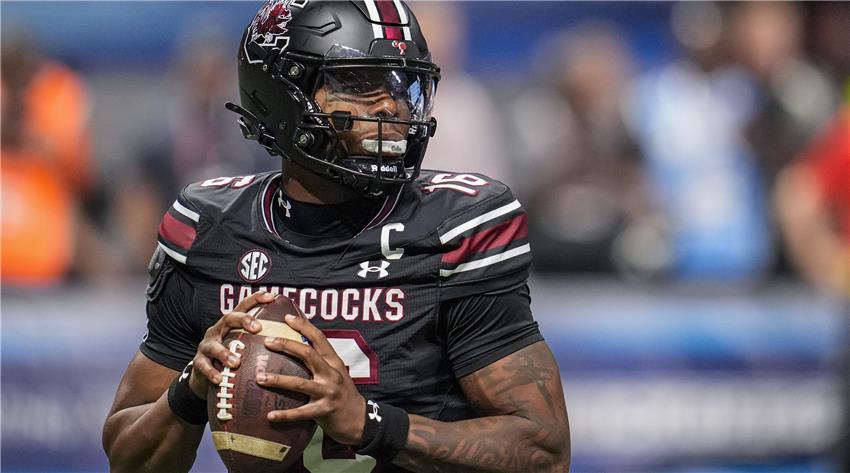
NFL Draft Buzz currently has Dante Moore, Julian Sayin and Arch Manning among its top four overall prospects, with five quarterbacks inside the first round of its board. Jeremiah Smith remains the top overall player, but the depth behind him at quarterback could make this draft revolve around the position anyway.
That sounds like plenty of supply.
It probably will not feel that way by April.
Quarterback classes become complicated once teams stop ranking players in a vacuum. Moore, Sayin and Manning are not interchangeable prospects, and NFL teams will inevitably develop strong preferences based on scheme, traits and organizational philosophy.
If four or five franchises enter the draft season convinced they need a long-term starter, owning the third pick instead of the seventh could be the difference between selecting a preferred quarterback and paying an enormous price to move up.
Four weeks into the NFL season, that race is already beginning to take shape.
Miami Has the Clearest Quarterback Decision
No team currently combines poor results and quarterback uncertainty as cleanly as Miami.
The Dolphins are 0-4, and Malik Willis has completed 58 of 103 passes for 712 yards with one touchdown and two interceptions. His mobility still creates plays outside structure, but Miami has not generated enough consistent offense through him to suggest the position should be considered settled.
The complication is financial.
Miami signed Willis to a three-year, $67.5 million contract with $45 million fully guaranteed after moving on from Tua Tagovailoa. That was not backup-quarterback money or a one-year audition. General manager Jon-Eric Sullivan and head coach Jeff Hafley knew Willis from Green Bay and clearly believed there was untapped starter potential.
But sunk cost should not become roster-building philosophy.
If Miami finishes with a top-three pick and believes Moore, Manning or Sayin can become a legitimate franchise quarterback, Willis' contract should not stop the Dolphins from making the selection. The more meaningful question will be whether four months of evidence gives the organization enough reason to believe the current experiment can still work.
For Miami, Moore would be particularly interesting. NFL Draft Buzz currently grades him as QB1, and his ability to attack the intermediate and deep areas of the field could give an offense that has lost much of its old star power something around which to rebuild.
If the Dolphins remain near the top of the order, quarterback will be impossible to ignore.
Arizona May Have the Cleanest Path to Starting Over
Arizona's situation is different because there is considerably less long-term commitment standing in the way.
The Cardinals entered the season with Jacoby Brissett, Gardner Minshew, Carson Beck and Kedon Slovis in the quarterback room. Brissett won the starting job, while Beck was always viewed as more of a developmental option who could potentially get his opportunity later in the season. Arizona's own preseason assessment of the quarterback room described the identity of QB1 as the team's biggest training-camp question.
Four weeks in, Arizona is 1-3.
Brissett has done enough to keep the offense functional, and the Cardinals have been more competitive than the record might suggest. That is still very different from having a long-term answer.
Beck matters to the equation. Drafting him gave Arizona an inexpensive developmental swing, and there is value in finding out what he can become. But a developmental quarterback should never prevent a franchise from selecting an elite prospect if it lands in position to do so.
Manning would make sense as the higher-variance swing. Moore currently offers the cleaner traditional projection, while Sayin's accuracy and anticipation could appeal to an offense designed around timing and distribution. Manning brings more creation ability and movement outside structure.
The Cardinals do not need to decide which profile they prefer in October. They do need to spend the next three months deciding whether anyone already in the building deserves to remove quarterback from the board.
The Jets and Saints Are Much More Complicated
This is where looking only at NFL records becomes misleading.
The Jets are 1-3, which naturally puts them into early mock-draft conversations. But Geno Smith's return to New York changed the short-term calculation. The Jets also drafted Cade Klubnik as a developmental quarterback, giving the organization another variable beyond the 2027 class. The team's own offseason review noted that the quarterback room had been redesigned around Smith and Klubnik.
Smith was extremely efficient through the first three games before struggling against Chicago in Week 4. At his age, he is not a reason to ignore a blue-chip quarterback prospect, but neither is New York in the same position as a franchise with no functioning veteran option and no developmental player on the roster.
New Orleans is similarly difficult to categorize.
The Saints are 1-3, but Tyler Shough is only in his second NFL season and has already shown enough to deserve a proper evaluation window. Through four games this year, he has produced a 410-yard, three-touchdown performance against Detroit and a four-touchdown game against Las Vegas.
Those performances have been mixed with mistakes and team inconsistency, but that is precisely why the evaluation needs context rather than a simple win-loss test.
If Shough spends the rest of the season proving he can operate the offense efficiently, New Orleans could use an early pick elsewhere. If his development stalls, the Saints suddenly become another bidder for the same small group of quarterbacks.
That uncertainty is what makes the 2027 race interesting.
A Bad Record Does Not Automatically Mean Quarterback
Tennessee is the clearest example.
The Titans are 0-4. If the draft were held tomorrow, they would be sitting near the very top of the order.
They still should not be considered an obvious quarterback destination.
Cam Ward was the No. 1 overall pick in 2025. Whatever concerns Tennessee has after a difficult start, the organization has barely begun the process of determining what it has in him. Using another premium selection on a quarterback after two seasons would require something far more significant than simply owning another high pick.
The same principle applies elsewhere. Houston and the Chargers are also winless, but C.J. Stroud and Justin Herbert fundamentally change how those teams would approach an early selection.
This distinction matters when projecting the 2027 draft. The teams most likely to earn the first few selections are not necessarily the teams most likely to draft quarterbacks.
And that is where the potential trade market becomes important.
Draft Position Could Be More Valuable Than the Quarterback Rankings
Through four weeks, Miami and Tennessee are both winless. So are Tampa Bay, Houston and the Chargers.
Those records look identical in the standings. The probability that each team actually finishes near the very top of the draft order is anything but identical.
The standings are not the only indicator worth watching this early. Sportsbook futures and prediction markets react to changes in team quality long before the draft order is locked, which can provide another useful signal when trying to separate a genuinely bad team from one experiencing a bad month.
Nate Lin, DFS Specialist at BettingScanner.com, puts it this way:
“Four weeks is still a tiny sample, so I don't care about the record by itself. I want to know what has changed underneath it - quarterback efficiency, injuries, schedule strength, whether the offense can sustain drives.
A 1-3 team that is still playing like a competitive roster is very different from a 1-3 team the betting markets keep downgrading every week. The record is the result. The underlying trend is what tells you whether it is likely to continue.”
A read of the current No. 1 pick market illustrates the point. In an October 6 snapshot, prediction markets priced Miami at roughly a 49% chance to earn the first selection, followed by Tennessee at 21%. Tampa Bay sat around 11%, the Jets at 7% and Arizona at 4%.
A simulation-based projection of the 2027 draft order reaches a similar conclusion from a different methodology. Miami is currently projected first and Tennessee second, with both carrying roughly a two-thirds chance of landing inside the top five. Arizona and the Jets are next among the teams most relevant to this quarterback discussion, each sitting around a 40% chance of a top-five selection.
Now consider what happens if Tennessee finishes first and Miami finishes sixth.
The Titans could have little incentive to select another quarterback. Miami could have every incentive in the world.
That is how the No. 1 pick becomes more valuable than simply the right to select the highest-rated player. If Miami, Arizona, the Jets or another quarterback-needy team decides there is one passer clearly above the others, Tennessee could suddenly control an auction.
The same applies if a non-quarterback team such as Houston or Los Angeles unexpectedly finishes at the top.
There may be five quarterbacks with first-round grades. There are still only a few draft slots that guarantee access to the best ones.
The 2027 Quarterback Class Could Create More Competition, Not Less
A deep quarterback class sounds like good news for teams searching for one, and in some ways it is.
But depth does not eliminate scarcity at the top.
NFL Draft Buzz currently has Moore, Sayin and Manning clustered among the very best players in the class, but their games are different enough that NFL front offices will not simply take whichever name remains.
One team may view Moore's passing profile as clearly superior. Another may believe Manning's physical ceiling is worth the risk. Another could prefer Sayin's processing and accuracy.
Once those preferences become conviction, draft position becomes leverage.
That is the real quarterback problem heading toward the 2027 NFL Draft. There may be several legitimate prospects available, but there could be even more teams looking for answers.
By April, owning a top-three selection may not simply determine which quarterback a franchise drafts.
It may determine whether that franchise gets one at all.