
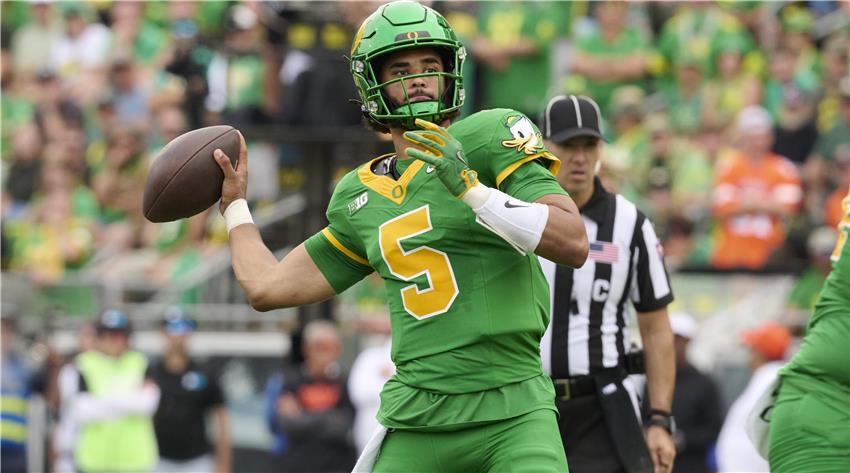
Oregon 84, Portland State 0, and the Case for a College Super League
Chris Fisk's team turned down a shorter second half. The bigger question is why the game was booked in the first place.
Oregon led Portland State 49-0 at halftime in Eugene on September 18. Before the third quarter, Oregon's staff offered to shorten the rest of the game to 10-minute quarters. Portland State declined. Oregon asked again later in the half and got the same answer.
The final was 84-0. That broke Oregon's school scoring record of 81 points, which was also set against Portland State, in 2023.
Chris Fisk, in his first year as Portland State's coach after seven seasons at Division II Central Washington, explained the decision in a statement to The Oregonian.
"We had been offered 10-minute quarters for both the third and fourth quarters and chose to play the full game," he said. "We chose that for the development of our program. We came to play 60 minutes, regardless of the outcome."
His team had spent the week piping crowd noise into practice to get ready for Autzen Stadium. Taking the shortcut would have sent those players a message Fisk clearly didn't want to send, and few coaches would have made a different call.
Dan Lanning didn't do much wrong either. Oregon's second half was mostly backups. Four quarterbacks threw passes, including Dylan Raiola and Akili Smith Jr. Eight players ran the ball and 14 caught a pass. Asked about it afterwards, Lanning brought up offensive lineman Fox Crader, who got 10 snaps against Montana State one year and was starting against USC a couple of weeks later.
So neither coach was the problem. The problem was the fixture, and there are plenty more like it on the calendar.
The price of a guaranteed win
Portland State arrived 0-3 and roughly a 60-point underdog. Oregon paid the Vikings $590,000 for the trip, according to Yahoo Sports, money that goes straight back into an FCS department with essentially nothing to spend on NIL or revenue sharing. Oregon's player compensation budget this year has been reported at around $50 million. Fisk pointed out before kickoff that one Oregon player's NIL deal was worth more than his whole operating budget.
Games like this are known as guarantee games, and the prices keep going up. Ohio State paid Ball State $1.9 million to come to Columbus in Week 1 and is paying Kent State the same in Week 3. Michigan paid Western Michigan $1.5 million. So did Alabama for East Carolina. For that money the home team gets a gate, a win and an easy afternoon for its starters. Usually that's what it gets, though Michigan came close to losing to Western Michigan in Week 1.
Blowouts have always been part of college football. Last season, though, opened with the most lopsided results in at least 25 years. Through three weeks the average margin in FBS games was 25.5 points, the widest at that point of any season since 2000, according to Sportradar numbers published by the Associated Press. Games involving power-conference teams averaged 28.9. Fifty-three had been decided by 40 or more.
The AP allowed that it might be a one-year blip. Scheduling explained some of it: 2025 had a record 126 games between FBS and FCS opponents. But somebody chose to schedule those games.
Why the gap keeps widening
Start with money. Since the House settlement, schools can pay players directly through revenue sharing, up to $21.3 million this year. The richest programs treat that figure as a starting point and add NIL money on top. CBS Sports reported this summer that Ohio State and Oregon each spend more than $40 million on their rosters. Maryland, in the same conference, is estimated at about $20 million. Illinois coach Bret Bielema told CBS he had changed his defensive scheme because he "couldn't afford to pay the numbers" for the type of lineman he wanted.
Then there's the transfer portal. A Group of Six school finds a kid the big programs missed, develops him for two years, and loses him as soon as he makes all-conference. CBS found that Group of Six teams held on to 29.5% of their returning all-conference players in the 2026 cycle. Power Four teams kept 74.6%. Of the 81 Group of Six all-conference players who left, 73 went to Power Four schools. The split doesn't stop there: the Big Ten and SEC kept 97.4% of those players, while the ACC and Big 12 kept 56.8%.
And the playoff rewards caution. Selection tends to punish a loss more than it credits a hard schedule, so a September game against a good opponent is a risk with little upside. An athletic director who books Portland State instead is doing what the system encourages.
Put those together and you get a sport that sorts its teams by payroll and then keeps scheduling the rich against the poor.
Who is this for?
Pick a Saturday in September and try to find the games worth planning an afternoon around. Out of 60-plus FBS games, it's usually a handful.
The long-run numbers back that up. Of more than 15,000 games between two FBS teams since 2005, about 35% were decided by eight points or fewer. Almost 23% were decided by 28 or more. And those figures leave out the FBS-versus-FCS games, which are the most one-sided of all.
Viewers already sort it out for themselves. All 10 of last season's most-watched college games were between ranked teams. Ohio State-Michigan drew 18.4 million. Ohio State-Texas pulled 16.6 million on opening weekend. The 100th most-watched game, Kentucky-Georgia, drew 3.68 million, and most games fall well short of that. Plenty are only on streaming.
Now look at this weekend. Saturday has the most conference games between ranked teams on a single day in AP poll history: Texas-Tennessee, Ole Miss-Florida, Texas A&M-LSU and more. Oregon, eight days after putting up 84, plays 12th-ranked USC. That's the sport at its best. It gets a day like this a few times a year, when the schedule happens to line up.
What the players get out of it
Very little, on either sideline.
Players get better by being tested, and a 60-point game doesn't test anyone. An edge rusher who spends the night beating a tackle with no pro future hasn't learned anything about his hands or his counters. A corner covering receivers who can't separate is taking part in a practice with a crowd. A quarterback who's never pressured isn't learning to throw under pressure.
Lanning's point about depth is fair, as far as it goes. But the backups are getting their reps against an overmatched opponent too, and the starters, who could use the work, are on the bench by halftime.
It catches up with teams. A team that wins by 50 every week in September can reach November without anyone finding its weak spots. Oregon probably found out more about itself losing to Oklahoma State in Week 2 than it did scoring 84 on Portland State.
Portland State's players, meanwhile, spent three hours getting hit by bigger, faster people. The check helps the budget. It's hard to argue it helped anyone on the roster, and in games like this the injury risk falls on the smaller team.
Bad tape
For anyone trying to evaluate draft prospects, the schedule creates a mess.
Season stats are the obvious issue. A receiver's 180 yards against an FCS secondary count the same as his five catches against a playoff opponent, and the season total is what ends up in the scouting report. A pass rusher's sack number can say as much about who he played as how good he is.
The tape matters more. What scouts want is film of a prospect against other future pros. With three or four guarantee games and a few lopsided conference games on the schedule, a starter at a top program might spend a big chunk of his season in games that were over by halftime.
It cuts the other way for players at smaller schools, who rarely see top competition at all. That's a big reason the Senior Bowl carries the weight it does. For some prospects the practice week in Mobile is the first time they've lined up against players at their level. Zach Wilson threw 33 touchdowns and three interceptions for BYU in 2020 against a schedule pieced together during the pandemic. He went second overall and never held down an NFL starting job.
Good evaluators adjust for opponent strength. They'd have less adjusting to do if the schedule gave them more real games to watch.
How the NFL does it
The league that gets its players from college football runs on the opposite model.
The worst NFL team drafts first. The salary cap keeps rich owners from buying titles. National TV money is split evenly across all 32 teams. Even the schedule helps: three of every team's 17 games are set by where it finished in its division the year before, so division winners play each other.
From 1999 through 2025, 50.7% of NFL games were decided by eight points or fewer. Since 2017 it's 52.7%. Between two FBS teams over a similar stretch, it's about 35%. In the NFL, a team going from last to first in a year is routine.
College football does nearly the reverse. The best players go where the money is, and the money stays with the schools that make it. The schedule shields good teams from each other.
College football has things the NFL can never have: rivalries older than the NFL itself, 100,000-seat stadiums, families who've held the same season tickets for three generations. But the NFL built its audience on the fact that most games on a given Sunday are in doubt. Until that's true on Saturdays, college football won't compete with the NFL week to week.
It can't copy the NFL wholesale. There's no draft, a salary cap would be a legal minefield, and there are more than 130 FBS programs. What it could copy is the idea that the best teams should play each other regularly.
A Super League
Put the top 32 programs in one league and have them play each other.
With 32 teams, every league weekend has 16 games between top teams. This Saturday, which is currently a record, would be a normal weekend.
The Champions League offers a workable format. It switched to a single league table in 2024. Seed teams into pots based on the previous season and give each team nine league games drawn across those pots, so everyone gets a mix of top, middle and bottom opponents. Leave three dates open for rivalry games outside the league, which protects Iowa-Iowa State, Florida-Florida State and games like them. The final table feeds the playoff, and the committee is no longer comparing records built against completely different schedules.
TV is where the money comes from. Ranked-versus-ranked games draw the biggest audiences by some distance, and a Super League would put 16 of them on every league Saturday. Every broadcast window would have a game people want to watch, and that revenue should be enough to pay for everything else.
Promotion and relegation would keep it honest. The bottom four drop to a second tier each year and the top four come up. That deals with the obvious complaint that this is just a rich schools' club: you earn your place and you can lose it. Relegated schools would get parachute payments for a season or two, as clubs dropping out of the Premier League do, so going down isn't a financial disaster.
Below the top tier, schools would play at their own level. Portland State would spend its fall playing teams it can beat. A share of the Super League's TV money would go down the pyramid as solidarity payments, replacing the guarantee-game checks FCS schools rely on now, without the 84-point loss that comes with them.
Something like this is forming anyway. The Big Ten and SEC keep taking a bigger share of the money and the players, and breakaway talk never quite goes away. SEC commissioner Greg Sankey brushed the idea off in 2024: "The fact that people have interest in throwing ideas out, that's up to them. I spend my time on what I have to do." The money has kept moving in the same direction since. College football can design a top tier with rules that protect competition and look after the schools below it, or it can end up with one anyway, without any of those rules.
Something to try now
A Super League would take years of negotiation between conferences, networks and universities. Some of the idea could be tested much sooner.
Leave the last three or four weeks of the regular season open and fill them by record, the way a Swiss-system chess tournament pairs players. 7-1 plays 7-1, 3-5 plays 3-5. Bubble teams would settle things on the field and November would be full of games with something riding on them. Add an automatic running clock once a lead passes a set margin, so no coach faces the choice Fisk faced, and stop counting FCS wins toward playoff eligibility. Most of the reason to book an Oregon-Portland State would go away.
The pushback
The obvious objection is Europe. The European Super League lasted about 48 hours in April 2021 before fan protests and the withdrawal of the six English clubs killed it. But it was built as a closed shop, with founding members who could never be relegated. A league with promotion and relegation is a different thing.
Tradition is the next complaint, and it's a fair one, but realignment has already broken up plenty of old conference rivalries without asking fans. Protected dates would keep the ones that matter most.
Smaller schools aren't in great shape under the current setup either. Being paid $590,000 to lose by 84 isn't much of a place in the sport. Promotion and solidarity money would give them more.
Travel and home games can be managed. Nine league games plus three protected dates can still work out to about half a team's games at home, and the pot draw can take geography into account.
It won't fix the money gap. Oregon will still spend many times what Portland State does. The difference is that they'd stop playing each other.
The legal and governance problems are real, and this sport doesn't reform itself quickly. The TV money gives everyone involved a reason to try.
Back in Eugene
Fisk made the right call for his team. His players stayed out there for all 60 minutes, and they'll remember that.
They shouldn't have been out there in the first place. Oregon's starters got nothing out of the night either, with USC a week away. The fans who bought tickets for an 84-0 game didn't get much more.
On Saturday night Oregon plays USC. Nobody is going to offer to shorten that one.